Summary:
- This detailed analysis evaluates India’s current political developments, historical evidence, and national security challenges.
- It includes an in-depth examination of Rahul Gandhi and his ideological ecosystem, the alliance of anti-India forces active domestically and internationally, controversial historical decisions of the Nehru-Gandhi family, and global as well as regional conspiracies targeting Sanatan culture and Indian identity.
- This article clarifies why national consciousness and public awareness are indispensable to protect India’s integrity, sovereignty, and social harmony.
The Alliance Of Disruptive Forces And The Lessons Of History: A Detailed National Analysis
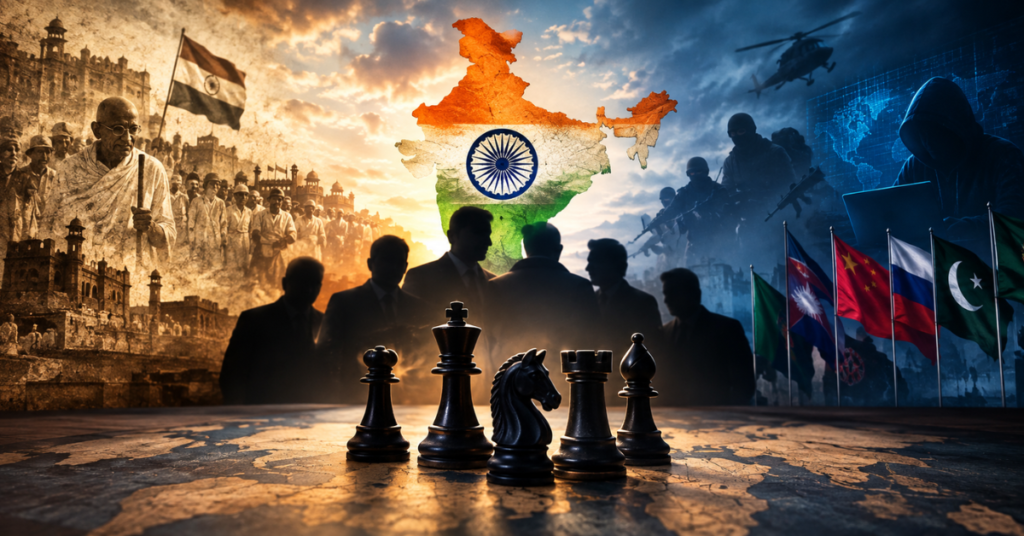
Politics in India today is no longer limited to an electoral battle or ideological differences between two political parties. This struggle is against a dangerous global and internal apparatus designed to undermine India’s sovereign existence, its thousands-of-years-old Sanatan cultural roots, and its rapidly emerging status as a global economic and strategic power.
The assemblage of ideologies and elements seen around and in support of Rahul Gandhi today does not represent a healthy democratic opposition. It is an organized tactical alliance of various disruptive forces challenging India’s integrity.
1. The Mobilization Of Anti-India And Anti-Sanatan Forces: A Toxic Ecosystem
At present, various discontented and extremist groups from home and abroad that resent India’s progress and cultural identity appear to be gathering under a single banner. The primary objective of all these components is to weaken the country’s security apparatus and tear its social fabric.
- The Khalistani and Separatist Agenda: Khalistani organizations (such as ‘Sikhs for Justice’) operating abroad (Canada, USA, UK) and harboring dreams of fracturing India issue open anti-India statements. These elements issue threats to overthrow the current government in order to recreate 1980s-style instability in Punjab and border states.
- The Radical and Fundamentalist Ecosystem: Ideological remnants of banned organizations like the PFI (Popular Front of India) remain covertly active today. These groups scheme under the guise of political turmoil to create demographic imbalances in the country and intimidate majority society.
- Urban Left-Wing Extremism (Urban Naxalism): Red terror, dismantled in the forests by security forces, has now established a foothold as ‘Urban Naxals’ across city universities, civil society, and media networks. Their role is to instill hatred among youth against the constitutional order and the Indian state.
- Illegal Conversions and Missionary Networks: Suspect organizations with foreign funding operating in North-Eastern states, tribal regions, and rural India are engaged in campaigns to destroy India’s core Sanatan cultural framework.
- Foreign Deep-State and George Soros Lobby: International institutions like ‘Open Society Foundations’ and foreign lobbies are spending billions of dollars to push a ‘Regime Change’ agenda in India, aiming to establish a weak, spineless government in Delhi that dances to their tunes.
All these anti-India components together seem to echo a single warning: “Let this strong leadership be removed once, and we will teach a lesson such that Hindus and India will never be able to raise their heads again.”
2. The Historical Track Record Of The Nehru-Gandhi Family: Obsession With Power And Severe National Blunders
When analyzing present political warnings and threats, it becomes imperative to examine those dark pages of history where the country was sacrificed to preserve power or conduct personal experiments.
- The 1947 Partition and Mass Massacre of Hindus: Pandit Jawaharlal Nehru’s haste and policy of capitulation before the British rule led to the tragic partition of India in 1947. This partition resulted in the slaughter of 1 to 1.5 million innocent Hindus and Sikhs, atrocities against millions of women, and the displacement of millions from their homeland as refugees.
- Surrender of Tibet and the 1962 Defeat: Nehru’s shortsighted ‘Hindi-Chini Bhai-Bhai’ policy allowed Tibet to be swallowed by China. Consequently, India suffered a humiliating military defeat in 1962 and the loss of thousands of square kilometers of territory.
- The 1975 Unconstitutional Emergency: When the Allahabad High Court invalidated former Prime Minister Indira Gandhi’s election, she imposed an Emergency across the country on June 25, 1975, to save her seat. Over 100,000 leaders, journalists, and citizens were thrown into jails, stifling democracy.
- The 1984 Sponsored Sikh Massacre: Following the assassination of Indira Gandhi, thousands of innocent Sikhs were burned alive in Delhi and other cities during Rajiv Gandhi’s tenure in 1984. Instead of expressing grief over this brutality, Rajiv Gandhi made the irresponsible statement that “When a big tree falls, the earth shakes.”
- The Shah Bano Case and Appeasement: Overturning the Supreme Court’s progressive judgment in 1985 to bow before Muslim fundamentalists was the pinnacle of the Rajiv Gandhi government’s appeasement policy, giving fresh impetus to radicalism in the country.
3. Rahul Gandhi’s Present Ideological Agenda: The ‘Muhammad Ghori Model’ And Social Division
Rahul Gandhi’s recent activities and rhetoric appear to be a modern iteration of these same destructive historical mistakes.
- Disparaging India on Foreign Soil: During his foreign visits (USA, UK), Rahul Gandhi meets with anti-India think tanks and anti-India figures like Ilhan Omar. Questioning India’s democracy, judiciary, Election Commission, and the neutrality of the armed forces on foreign platforms is a direct attempt to weaken the country internationally.
- Adopting the ‘Muhammad Ghori Strategy’: Just as Muhammad Ghori in the 12th century seized power in Delhi by exploiting internal rifts among Indian kings and traitors; similarly today, foreign powers are being invited to interfere in India’s internal affairs.
- Caste Census and ‘Divide and Rule’ Policy: Rahul Gandhi is instigating division through caste lines to shatter the collective strength of Sanatan society. Slogans like “Jitni Aabadi, Utna Haq” (Share proportional to population) are being used to divide Hindus into fragmented pieces so that India can never stand as an organized, empowered nation.
- Distrust in Institutions and Fostering Anarchy: Demanding proof for surgical strikes, undermining the morale of the Indian Armed Forces during border disputes with China, and continuously disrupting parliamentary proceedings reveal a single intent—to spread administrative and social chaos in the country.
4. Conclusion: Conscious Citizens are the True Shield Of An Undivided India
History teaches us that whenever India has been divided by internal contradictions, caste divides, and petty self-interests, foreign invaders and traitorous elements have taken advantage to push us into centuries of subjugation.
Today’s India is not the helpless India of 1947, 1975, or 1984. Today’s India is a self-reliant nation, globally respected, and proud of its cultural heritage.
However, if national security and Sanatan culture are compromised for political ambitions and foreign agendas, future generations will pay a heavy price. Therefore, it is the paramount duty of every Indian citizen to rise above the bonds of caste, region, and language, unite in the national interest, and stand as an impenetrable shield against forces seeking to break the nation.
🇮🇳 Jai Bharat, Vandematram 🇮🇳
Read our previous blogs 👉 Click here
Join us on Arattai 👉 Click here
👉Join Our Channels👈