Summary:
- This detailed analysis presents an objective review of the misleading claim—emerging in the backdrop of the 2024 Lok Sabha election results—that the Central Government has neglected the majority community.
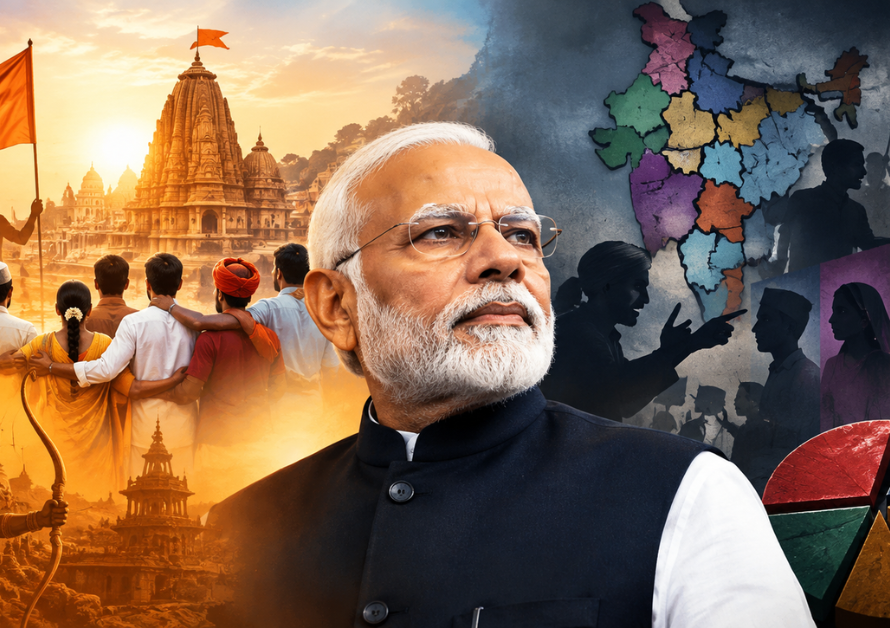
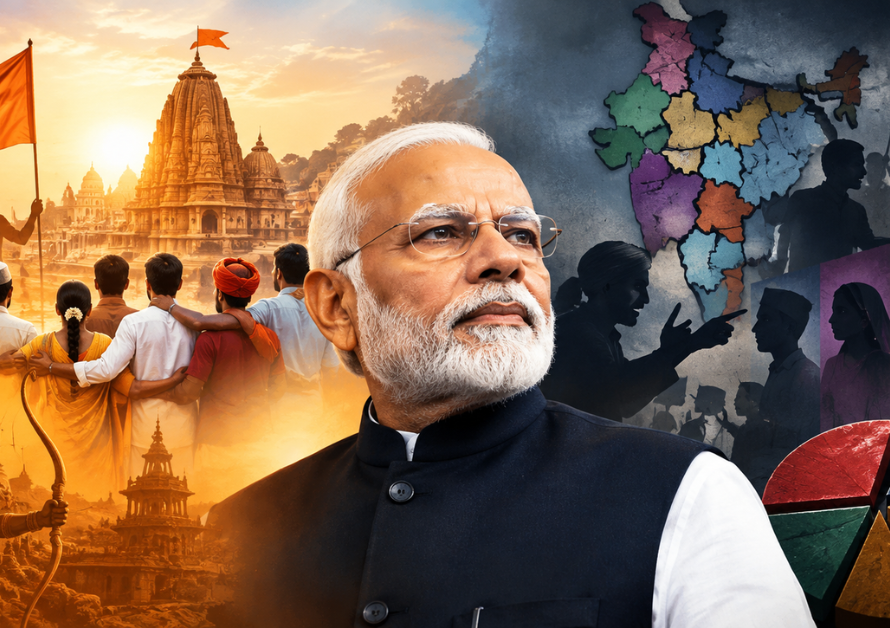
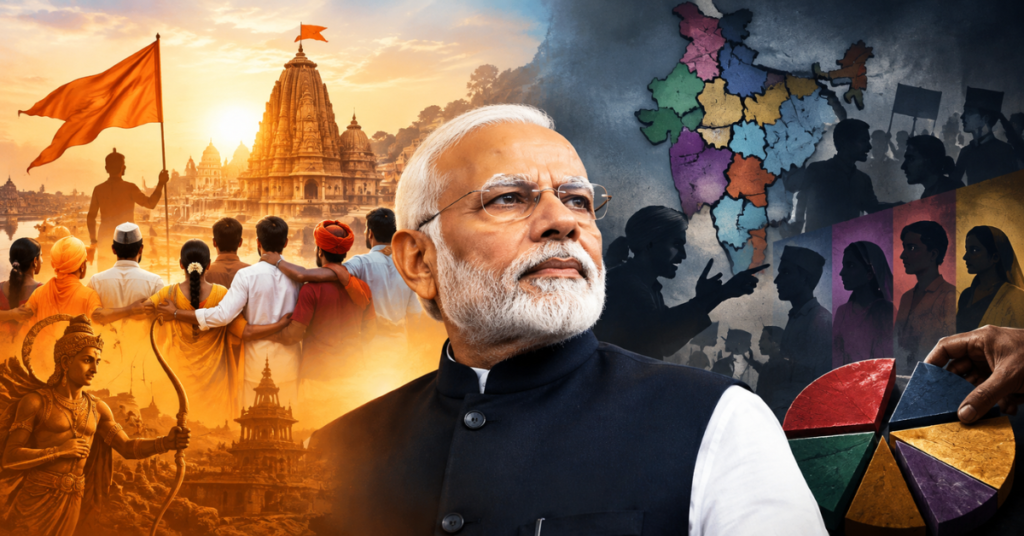
- Based on demographic data and electoral polarization principles, this article demonstrates that despite the construction of the Shri Ram Janmabhoomi Temple after a 500-year struggle and a broader cultural renaissance, the majority community’s vote fractured along Mandal 2.0 and caste lines.
- Through the demographic equations of four key Lok Sabha seats in Uttar Pradesh—Ghazipur, Kairana, Saharanpur, and Sambhal—it highlights how even in regions with up to 90% majority population, the absence of strategic consolidated voting and divisions across caste lines handed opposition candidates a decisive edge.
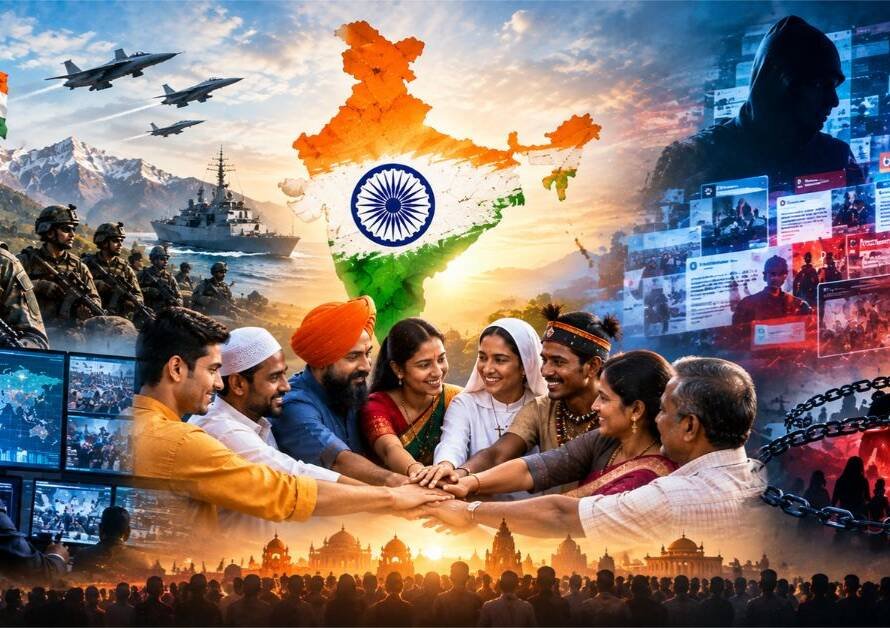
- The article issues a clear call to action for the majority community to embrace the resolve of ‘Nation First’, shatter caste barriers, awaken self-respect, and actively partner with the government rather than remaining passive spectators.
The Illusion Of ‘Anti-Hindu Modi’, Cultural Renaissance Vs. Caste Fragmentation—A Comprehensive Analysis
1. The Illusion Of The ‘Anti-Hindu Modi’ Narrative And The Reality Of Cultural Renaissance
In recent times, certain political circles have attempted to craft a misleading narrative asserting that the leadership of Prime Minister Narendra Modi and Chief Minister Yogi Adityanath has disregarded the cultural and social interests of the majority community or the upper castes. However, viewing the decisions of the past decade and the pages of history objectively renders this claim entirely groundless.
- Historic Decisions of Cultural Revival:
- The construction of the grand Shri Ram Janmabhoomi Temple in Ayodhya and the Pran Pratishtha (consecration) of Ram Lalla, following 500 years of relentless struggle and complex legal battles, stands as the crowning cultural achievement of the Modi-Yogi era.
- The expansion of the Kashi Vishwanath Dham Corridor, the creation of Shri Mahakal Lok in Ujjain, the redevelopment of Kedarnath and Badrinath Dhams, and the Kartarpur Sahib Corridor have re-established India’s cultural identity on the global stage.
- Constitutional and Security Reforms:
- The abrogation of Article 370—fully integrating Jammu & Kashmir into India’s mainstream—and the implementation of the Citizenship Amendment Act (CAA) to grant sanctuary to persecuted minorities (Hindus, Sikhs, Buddhists, Jains) from neighboring nations were decisive steps taken in the long-term national interest.
- The Paradox of 2024:
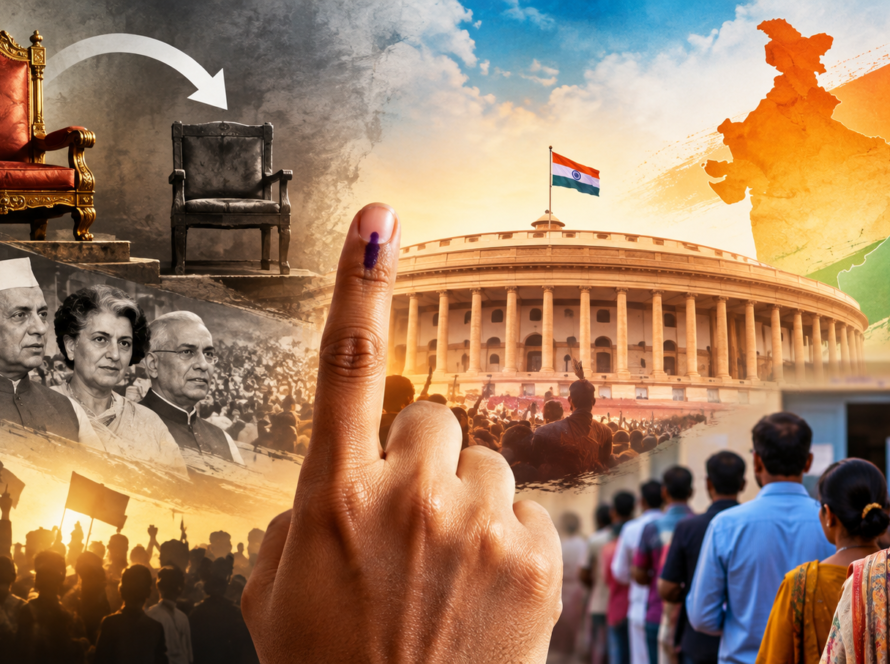
- Despite these monumental decisions, the ruling party’s tally dropping from a full majority (272+) to 240 seats in the 2024 general elections—along with its seat count being halved in a pivotal state like Uttar Pradesh—exposes how localized caste identities overshadowed national and cultural consciousness on the electoral battleground.
2. Electoral Arithmetic And Demographics: A Deep Dive Into Four Key Regions Of Uttar Pradesh
Demographic data and the 2024 results across key Lok Sabha constituencies in Uttar Pradesh offer stark proof of how even a large majority population turned into an electoral defeat due to caste fragmentation.
- Ghazipur (Victory of SP Candidate Afzal Ansari):
- Demographics: In the Ghazipur constituency, the majority Hindu population and electorate stand at approximately 89.3% (over 1.6 million voters).
- Electoral Analysis: Despite a nearly 90% majority population, Samajwadi Party candidate Afzal Ansari secured victory. The primary reason was that the 1.6 million Hindu voters split completely across Yadav, Rajput, Dalit, Bind, and other caste lines. As the majority vote fractured among 4 to 5 different candidates and castes, a consolidated 10% minority and co-caste vote bank voted en masse to decide the election outcome.
- Kairana (Victory of SP Candidate Iqra Hasan):
- Demographics: The Kairana Lok Sabha constituency comprises approximately 58% to 60% Hindu voters (around 1.1 to 1.2 million), while the Muslim population stands at roughly 40%.
- Electoral Analysis: This seat witnessed a strategic consolidation of over 85% of minority votes in favor of the opposition alliance. Conversely, the 60% majority population’s vote fragmented across Jat, Gurjar, Saini, Kashyap, and Dalit castes. Mathematically, a divided 60% vote lagged behind a consolidated 40% turnout.
- Saharanpur (Victory of Congress Candidate Imran Masood):
- Demographics: Out of a total of 1.85 million voters, Hindu voters account for roughly 56% to 58% (1.05 to 1.1 million), while Muslim voters account for approximately 41% to 42% (650,000 to 700,000).
- Electoral Analysis: Minority voters prevented any division in their ranks, extending unified support to the Congress candidate. In contrast, a significant portion of the majority community dispersed due to caste loyalties, localized discontent, and low voter turnout, shifting the result in favor of the opposition.
- Sambhal (Victory of SP Candidate Zia-ur-Rehman Barq):
- Demographics: In a sensitive constituency like Sambhal, the Hindu population hovers near 48% to 50% (850,000 to 900,000).
Electoral Analysis: Where the contest is nearly 50-50, even slight electoral apathy or caste-based division within the majority community proves fatal. In Sambhal, the split in Hindu votes directly benefited the disciplined, consolidated polling of the opponent.
3. Key Dimensions Of Electoral Polarization And Voter Behavior
Voter behavior in the 2024 Lok Sabha elections, particularly in Uttar Pradesh and the Hindi heartland, revealed three major trends:
- The Impact of Mandal 2.0 over Cultural Achievements:
- During the election, broader themes like national security, the Shri Ram Temple, and cultural pride receded into the background. The narrative propagated by the opposition regarding ‘changing the Constitution’ alongside promises of a caste census once again divided the majority community into narrow caste silos.
- Strategic Consolidation vs. Vote Splitting:
- A specific section of society voted without ambiguity for whichever candidate was best positioned to win, solely to safeguard their political interests. In contrast, the majority community lacked cohesive solidarity voting, splitting across caste considerations and local candidate preferences.
- Discontent and Apathy among Upper Castes and the Middle Class:
Dissatisfied over reservations, candidate selection, and government policies, a significant segment of the upper castes and middle class either abstained from visiting polling booths due to the intense summer heat (Low Voter Turnout) or opted for NOTA and opposition candidates. This apathy directly handed an advantage to opposition candidates backed by disciplined vote banks.
4. Rising Above Caste Divisions For ‘Nation First’: A Call For Survival
An analysis of civilizational consciousness and the lessons of history clarifies that no society or nation can safeguard its long-term existence solely by relying on governments.
- Centuries of Oppression and the Lessons of History:
- History bears witness that India endured centuries of foreign invasions, colonial exploitation, and cultural devastation precisely because our society was divided into petty silos of castes, regions, and selfish interests. Whenever personal or caste-based interests were placed above the ‘Nation’ and ‘Culture’, our enemies exploited this exact weakness to crush and humiliate us.
- The Urgent Need to Tear Down Caste Barriers:
- Until the majority community breaks free from narrow caste, sub-caste, and petty selfish boundaries to internalize the supreme motto of ‘Nation First’, this cycle of suffering cannot end. Caste pride is meaningless without the survival of the nation and culture. If our culture and nation themselves do not remain secure, caste identity will hold no value whatsoever.
- Governments Alone Cannot Work Miracles:
- No government—no matter how culturally aligned or nationalistic—can perform miracles solely on the strength of its policies or political power. Without active societal support, cultural awareness, and unbroken solidarity at the polling booth, even government policies and efforts will fall short. Epochal change occurs only when leadership and society step forward in unison.
- Shortage of Time and the Imperative to Awaken:
- The time for slumber or neutrality has passed. The pace of demographic shifts, global ideological campaigns, and internal forces seeking to tear our social fabric apart is so rapid that if the majority community fails to wake up now, the situation will pass beyond the point of recovery. We have very little time left, and awakening and acting today is imperative to safeguard the existence and dignity of future generations.
5. Conclusion: Lessons From The Election And The Future Of The Majority Community
The 2024 election results offer a profound lesson for the majority community and the nation as a whole.
- Solidarity, Not Numbers, Determines Power: The Ghazipur example suffices to prove that even a 90% population, if fractured, can be defeated by a 10% organized vote bank.
- The End of the ‘All is Well’ Illusion: The misconception that ‘all is well’ and ‘our government will inevitably remain in power’ has rendered the majority community politically complacent. Until society prioritizes nation and dharma above caste, the balance of political power will continue to shift away.
Final Message: In a democracy, political strength is not determined by schemes, speeches, or population figures alone; it is determined by which community stands united at the polling booth on election day. If the majority community fails to rise above caste divisions and selfish interests to stand firm with the resolve of ‘Nation First’, history will not forgive us. Time is running out; awaken, unite, and play an active role in nation-building before it is too late to recover.
🇮🇳 Jai Bharat, Vandematram 🇮🇳
Read our previous blogs 👉 Click here
Join us on Arattai 👉 Click here
👉Join Our Channels👈