Summary
- This article presents an in-depth political and economic analysis of the recent policy announcements made by TVK leader Joseph Vijay in Tamil Nadu, as well as the administrative policies of other opposition/coalition-ruled states.
- The analysis highlights how targeted freebies and budgetary allocations are being distributed to minority communities (Muslims and Christians) primarily to retain power.
- Such religion-based welfare schemes place an excessive financial burden on the state exchequer, exhausting budgets that would otherwise be allocated for infrastructure, industrial development, and capital expenditure.
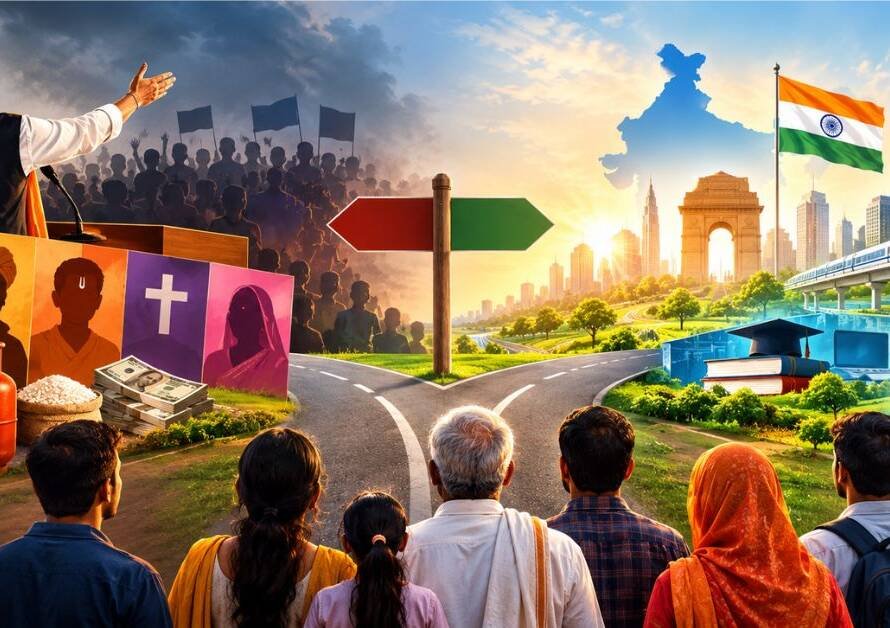
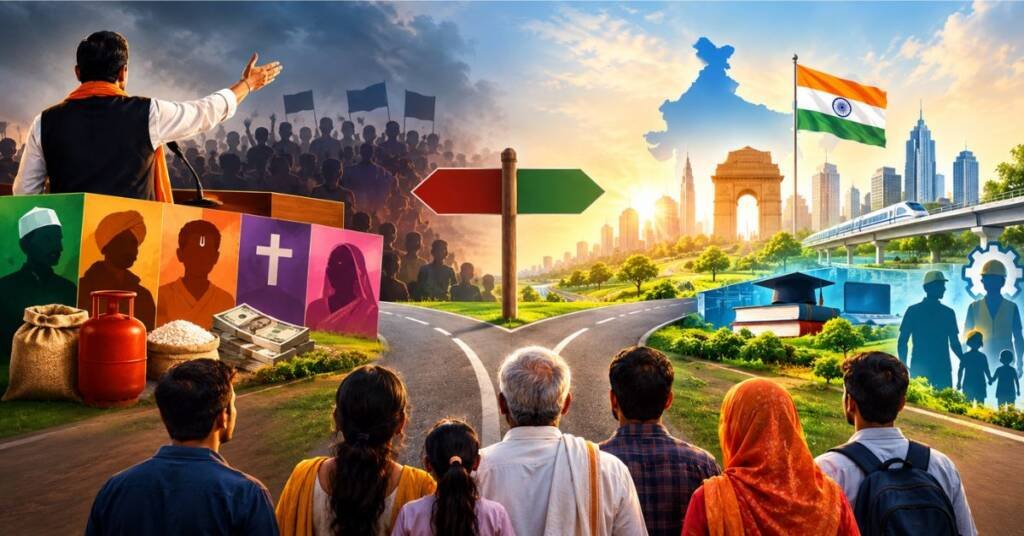
- Drawing a comparison with the pre-2014 “Fragile Five” era, this article emphasizes why it is essential to end appeasement politics and support the nationalist NDA development model to transform the nation into a global superpower and Vishwaguru.
A Policy Analysis of Tamil Nadu and Opposition-Ruled States
1. Controversial Decisions and Announcements by Joseph Vijay in Tamil Nadu
Recent political developments in Tamil Nadu clearly reveal the policy direction of the state. The announcements made under the leadership of Joseph Vijay demonstrate a focus on targeted appeasement rather than all-inclusive development.
- Unprecedented Increase in Haj Subsidy: Financial assistance for first-time Haj pilgrims has been increased from ₹25,000 to ₹35,000.
- Full Tuition Fee Waiver for Muslim Female Students: The state government will cover the entire college tuition fees for Muslim female students enrolled in undergraduate (UG) courses under the government quota.
- Interest-Free Loans for Community Properties: A decision has been taken to provide interest-free loans from the state treasury exclusively for the maintenance and upkeep of public and community properties of the Muslim and Christian communities.
- Creation of New ‘District Minority Officers’ Posts: New government posts for ‘District Minority Officers’ are being created across 10 new districts in the state to oversee schemes dedicated exclusively to one segment.
- Heavy Budgetary Allocations for Religious Structures:
- A direct grant of ₹10 crore has been allocated for the restoration and conservation of ancient and historical churches.
- A massive allocation of ₹40 crore has been designated for constructing a modern, fully equipped building for the Tamil Nadu Waqf Board.
- Extension of Scholarship Schemes: Scholarships previously available to Muslim female students from Classes 1 to 8 have now been extended to Classes 9 and 10, alongside financial support for vocational skill training.
2. Reiteration of the Seven-Decade-Old Appeasement Policy
This issue is not confined to a single state; it reflects the long-standing operational model of opposition and coalition parties.
- Narrow Vote-Bank Politics: For the past seven decades, special concessions and freebies have been distributed to Muslim and Christian minorities to secure a consolidated vote bank for political survival.
- Neglect of Genuine Minorities: In the pursuit of vote-bank politics, smaller minority communities such as Jains, Sikhs, and Buddhists have been marginalized because they do not form an organized political vote bank.
- Discrimination Against the Majority Population: When policies are framed on the basis of religious identity rather than universal development, the majority population and other needy sections feel neglected.
3. Empty Treasuries: The Deepening Financial Crisis in States
Freebies and appeasement schemes have severely strained the economic health of opposition-ruled states. The misuse of state resources has escalated to a point where a near-financial emergency exists.
- Salary and Bill Payment Crisis: State treasuries have been emptied to such an extent that governments are finding it difficult to pay timely salaries to government employees or clear routine treasury bills.
- Halt on Infrastructure and Development: When a major portion of revenue is consumed by Direct Benefit Transfers (DBT) and targeted subsidies, the budget for constructing roads, bridges, hospitals, and power projects drops to zero.
- States Trapped in Debt: Taking on massive debt for short-term political gains instead of long-term development has pushed the Debt-to-GDP ratio of these states to precarious levels.
4. Pre-2014 Era vs. Present-Day Resurgent India
The current situation mirrors the pre-2014 period when India was categorized among the world’s most vulnerable economies—the “Fragile Five.”
- The Era of Dynastic Politics and Corruption: Prior to 2014, dynastic leaders and political establishments prospered while the national exchequer was drained, leaving the public to endure economic hardship.
- NDA’s Infrastructure-Led Model: After 2014, under the leadership of Prime Minister Narendra Modi, the nation moved past policy paralysis to embrace decisive economic reforms, a world-class highway network, digital public infrastructure, and the vision of Atmanirbhar Bharat.
- Freebie Model vs. Capital Formation: On one side lies a model that drains the exchequer and cripples the economy; on the other lies a nationalist model focused on long-term asset creation and job generation.
5. Message to the Nation
To prevent the nation from reverting to the declining conditions of the pre-2014 era and to build a fully developed nation, political maturity is essential.
- Uprooting Appeasement: The electorate must decisively reject coalition politics that drains state resources and divides society.
- Supporting Nationalist Policies: Standing behind the nationalist NDA vision—focused on national security, economic stability, and robust infrastructure—is the need of the hour.
- The Resolve for Vishwaguru: India can attain its stature as a global superpower and Vishwaguru only when state and central governments prioritize national interest and equitable development above all else.
🇮🇳 Jai Bharat, Vandematram 🇮🇳
Read our previous blogs 👉 Click here
Join us on Arattai 👉 Click here
👉Join Our Channels👈