Summary
- This detailed geopolitical and socio-political analysis presents the historic political transformation in West Bengal (the rise of a nationalist government under the leadership of Suvendu Adhikari) from a global perspective.
- It shows that this was not merely an internal state election, but a critical turning point that demolished the well-crafted propaganda of the Western media, altered the security equations of neighboring Bangladesh, and exposed the hidden matrix of global superpowers (the US, China, and Donald Trump) designed to contain India’s growing economic, military, and strategic might.
- This narrative unmasks both the internal and global conspiracies against India, charting the saga of a powerful, self-reliant, and awakened nation.
- Website:https://www.saveindia108.in
- Email: info@saveindia108.com
- Old Blogs: https://saveindia108.in/our-blog/
- WhatsApp: https://tinyurl.com/4brywess
- Arattai: https://tinyurl.com/mrhvj9vs
- Telegram: https://t.me/+T2nsHyG7NA83Yzdl
I. Introduction: The Echo of the Oath and Global Tremors
The moment political transformation swept through West Bengal and Suvendu Adhikari took the reins of power, the echoes were not confined to Kolkata or Delhi. It shook global corridors from New York and London to Dhaka and Beijing. While elections happen periodically across various states in India, the global media and international think-tanks descended upon the Bengal results as if it were a major international event.
- A State Election, a Global Concern: Political analysts worldwide were stunned by how an election in Bengal could suddenly compel newspapers in the US, Europe, Bangladesh, China, and Turkey to focus entirely on one name—Narendra Modi.
- The Abrupt End of Propaganda: Following the 2024 general elections, international media had begun establishing a specific narrative that Prime Minister Narendra Modi’s political grip was weakening and that the influence of cultural nationalism was fading in India. The Bengal results completely dismantled this entire agenda in a single stroke.
- The Shift in Foreign Media: Institutions that were critical of India’s policies and nationalism just yesterday suddenly shifted to analyzing and praising its organizational capacity and political willpower.
II. The U-Turn of International Press and New Analysis
As the political fortress of Bengal fell, the world’s most prestigious newspapers and news agencies were forced to alter their headlines. Their analysis shifted from looking for flaws in India to focusing on Prime Minister Modi’s invincible political strategy.
- The BBC’s Stance: In its primary analysis, the BBC noted that Narendra Modi’s BJP had conquered India’s most difficult, complex, and ideologically volatile political front. This victory demonstrated that the roots of nationalism have deepened even in the country’s most challenging regions.
- The Guardian: The British daily labeled this an “historic and irreversible shift” in Indian politics. This implied that the core center of Indian politics is no longer leftist or regional appeasement ideologies, but cultural nationalism.
- The Washington Post: This prominent American newspaper explicitly wrote that Prime Minister Narendra Modi has once again left all his domestic and international critics far behind. Those who underestimated him were completely oblivious to the ground reality.
- Germany’s DW: German media looked beyond a mere provincial win or loss. According to them, this is the turning point in India’s national politics that will shape both its domestic and foreign policy for decades to come.
III. Why the Fall of the ‘Bengal Fortress’ is Geopolitically Critical
For foreign strategists and the global deep state, West Bengal has long been considered a highly sensitive and vital region within India. Due to its political history and geographical location, it was viewed as one of the country’s most impenetrable fortresses against nationalism.
- Control Over the Eastern Gateway: West Bengal is the eastern flank of India, sharing highly sensitive international borders. It acts as the gateway to the northeastern states. A nationalist government here makes India’s internal and external security virtually impregnable.
- The Collapse of a Decades-Old Ideological Wall: Since independence, Bengal was the stronghold first of Communism and later of the Trinamool Congress’s aggressive regional and appeasement politics. Foreign think-tanks believed that Bengal’s unique demographics and ideological framework made the entry of nationalist forces impossible. When this wall crumbled, the world realized that Modi’s organizational power transcends geographical boundaries.
- The Fall of the Opposition’s Last Bastion: The New York Times acknowledged in its analysis that this defeat is a blow to the survival of the Indian opposition from which it may be nearly impossible to recover. Bengal was the last major platform used to build a counter-narrative against the central government in the name of a “threat to the federal structure” and regional identity.
IV. Bangladesh’s Anxiety: The End of the ‘Appeasement Shield’
The deepest and most immediate impact of this historic shift was felt in neighboring Bangladesh. An unfamiliar anxiety and panic gripped the political, administrative, and strategic corridors of Dhaka, as their decades-old political comfort zone vanished overnight.
- Dependence on the Previous Policy: The Bangladeshi government and its policymakers always felt secure with the presence of the Trinamool government in West Bengal. Whether it was the Teesta water dispute, cross-border illegal trade, or demographic shifts, Kolkata’s stance had consistently served to slow down or stall the firm, nationalist policies of the central government.
- A Direct Blow to Illegal Infiltration and Smuggling: Following the change in power, Bangladeshi media openly expressed fears that illegal infiltration and organized cattle smuggling across the border would face a complete shutdown. The previous lack of coordination between the BSF and local administration will now be resolved, permanently closing the doors for illegal elements entering from Bangladesh.
- Strict Implementation of CAA and NRC: The ground implementation of stringent national security laws like the Citizenship Amendment Act (CAA) and the National Register of Citizens (NRC) in border areas will now proceed without any regional political interference. This has become a major concern for Dhaka, as it facilitates the swift identification of illegal cross-border demographics.
V. Asia’s Balance of Power and the Explicit Message for 2029
This victory not only demoralized the domestic opposition but also sent a clear message to India’s adversaries globally: halting the ‘Modi Era’ and India’s developmental momentum is now beyond anyone’s control.
- China’s Strategic Concern: The South China Morning Post (SCMP), which is closely linked to China’s state apparatus, analyzed in a special report that the rise of a strong nationalist government in Bengal tilts the power politics of South Asia heavily in India’s favor. India’s eastern flank is becoming strategically secure, which will make India’s ‘Look East’ policy far more aggressive, posing a direct challenge to China’s expansionist designs in the Indo-Pacific.
- The Altered Assessment of Turkey and the Middle East: Turkey’s leading newspapers and the Arab world’s Al Jazeera admitted that global powers predicting the decline of the BJP and Modi were proven completely wrong. India is now free from internal political distractions, leaving it at liberty to act as an assertive and independent superpower on the world stage.
- Setting the Course for 2029: International analysts now believe that this Bengal victory has already laid the foundation for the 2029 general elections. The result proves that the acceptance of nationalism has become omnipresent across all corners of the country.
VI. The Real Game: The Triangular Matrix of the US, China, and Thugbandhan
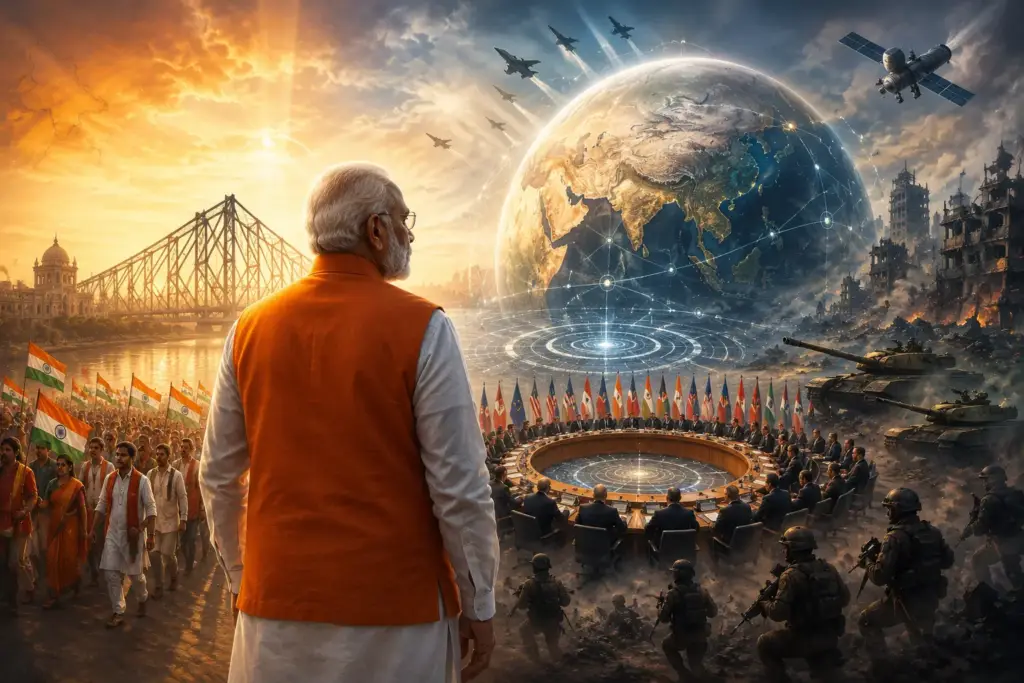
However, this story is not merely about a provincial election or a single state victory. The real game behind it is much deeper, broader, and more dangerous, operating behind the scenes at a global level. Recent events in global geopolitics confirm this hidden agenda.
- The Mystery Behind Halting the Iran Conflict and Trump’s Focus on China: In the global arena, the sudden de-escalation of potential conflict with Iran by the US and Donald Trump’s immediate pivot toward China as a primary strategic priority is no ordinary diplomatic maneuver. It is a direct signal that the ultimate objective of the world’s two largest superpowers is to focus their full energy on the Asia-Pacific.
- A Hidden International Consensus to Contain India: While the US and China may be fighting a trade war or facing off over Taiwan, their interests align perfectly on one front: preventing India’s rising economic, military, and technological power and keeping it within check.
- Intolerance Toward India’s Rising Stature: The way India is becoming entirely ‘Self-Reliant’ (Atmanirbhar), asserting an independent and bold foreign policy on global platforms, and emerging as a just mediator in crises ranging from the Russia-Ukraine conflict to Middle East tensions, is bruising the hegemony of both the US and China.
- Tactics to Block India from Leveraging Global Instability: The US is well aware that if it remains entangled in major conflicts in the Middle East, India will leverage this global instability to accelerate its own economy—just as it did during the Russia-Ukraine conflict by purchasing affordable energy and safeguarding its national priorities. Consequently,
- Western powers are shifting their strategies to disrupt India’s growth rate, attempting to create a new balance of power alongside China to ensure India remains contained.
VII. Conclusion: The Clarions of a Self-Reliant and Awakened India
The result in West Bengal is not just a victory for a political party or a leader; it marks the dismantling of the global matrix that foreign powers had long been designing to spark civil unrest and weaken India from within.
- National Security Reaches the Forefront: Critical issues like illegal infiltration, demographic imbalances, and internal security, which were previously drowned out by the noise of regional politics, have now become the core focus of national security policy.
- A Clear Message to Global Powers: India has made it absolutely clear that it will not bow to any international pressure when it comes to protecting its borders, its sovereignty, and its culture.
- Steps Toward Becoming a Vishvaguru: No matter how complex a matrix global superpowers design, and regardless of the diplomatic maneuvers executed by the US and China, India will neither slow down nor back down. The voice of nationalism rising from Bengal is a harbinger of a changing direction for all of South Asia. It is the clarion call of a powerful, self-reliant India moving toward its supreme glory and rising as a Vishvaguru.