Summary
- Building collapses in densely populated areas of Delhi—such as Satya Niketan, Karol Bagh, or Chandni Chowk—are not merely sudden accidents or local administrative failures. They reflect the cumulative impact of historic policy oversights, decades of unchecked urban sprawl, and civic apathy.
- In 1947, following independence, the government had a unique opportunity to develop a modern, well-structured urban model given the ample land availability and significantly lower population. However, instead of executing long-term master plans with strict building regulations, urban expansion proceeded on an ad-hoc, need-driven basis.
- Consequently, colonies were constructed without modern drainage, ventilation, or safety compliance to accommodate refugee rehabilitation and urban migration. In the decades leading up to 2014, political appeasement and vote-bank mechanics led to the indiscriminate regularization of unauthorized colonies, worsening the structural crisis.
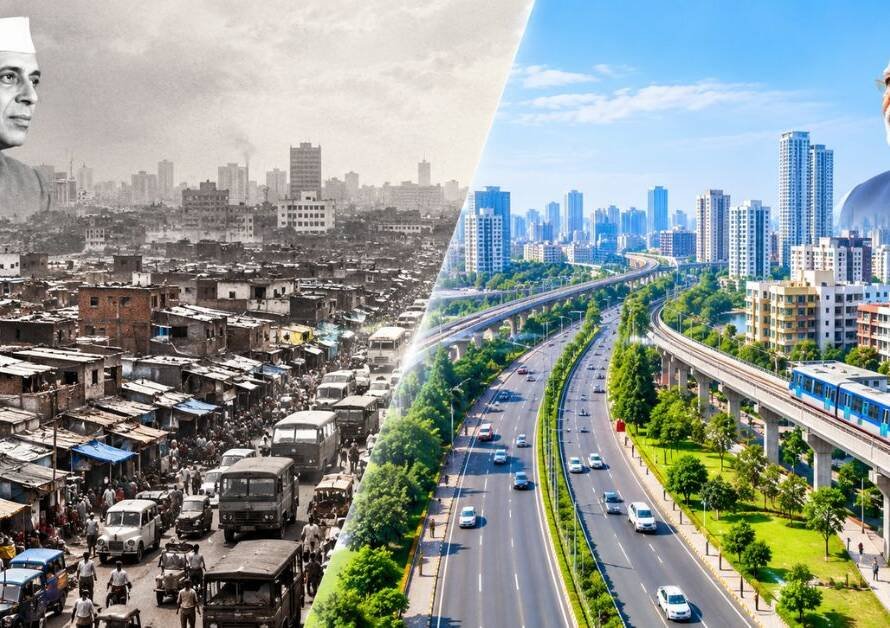
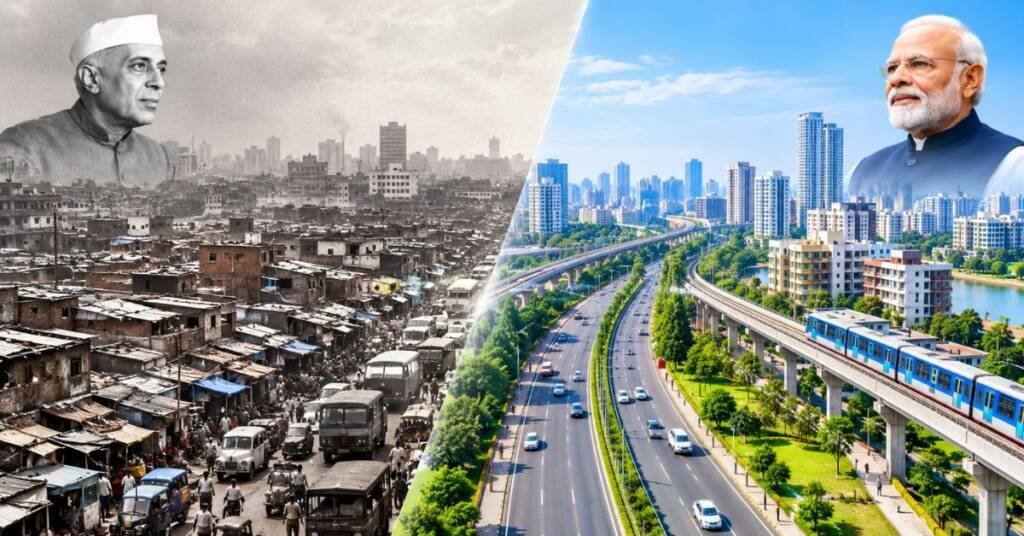
- However, a fundamental shift occurred after 2014. Over the past 12 years, development projects have been executed systematically—utilizing GIS-based master planning, strict regulatory enforcement, and uncompromising safety standards without political pressure or appeasement.
- Nevertheless, a permanent solution for decades-old, dilapidated structures requires citizens to accept moral responsibility alongside strict administrative enforcement to eliminate illegal encroachments.
From the Shortcomings of the Nehruvian Era to Post-2014 Planned and Secure Development
1. Historical Opportunities and Early Policy Shortcomings (1947–1960s)
Post-independence India possessed a major historical window to design its capital and major urban centers according to world-class standards:
- Favorable Land-to-Population Ratio: In 1947, India’s total population was less than a third of what it is today. Ample land was available in and around Delhi to build planned, grid-based cities without structural constraints.
- Lack of Long-Term Vision: While Western nations in the mid-20th century implemented grid-based master plans featuring wide roads, underground sewage systems, proper ventilation, and emergency service lanes, urban planning in India remained limited to immediate rehabilitation needs.
- Pressures of Partition and Migration: To rapidly house displaced populations following Partition, areas such as Karol Bagh, Patel Nagar, and Lajpat Nagar—and later, broader stretches of Trans-Yamuna, Janakpuri, and Sangam Vihar—were developed rapidly without modern structural safety protocols.
- Neglect of Basic Construction Standards: Early urban layouts failed to strictly enforce provisions for rainwater harvesting, adequate parking spaces, or minimum road widths required for fire tenders and emergency vehicles.
2. Vote-Bank Politics, Appeasement, and Expansion of Unauthorized Structures
In the decades prior to 2014, the administrative and political setup prioritized vote-bank appeasement over regulatory compliance:
- The ‘Build First, Regularize Later’ Model: In countless localities like Sangam Vihar, Shahdara, and Shastri Park, multi-story structures were erected without sanctioned building plans or municipal approvals.
- Pre-Election Appeasement Politics: Prior to elections, political parties routinely competed to regularize illegal colonies, setting aside basic standards of structural stability, ventilation, and fire safety for short-term political gains.
- Administrative Corruption and Neglect: Due to political pressure and systemic corruption, local municipal bodies (such as MCD/DDA) and field inspectors consistently overlooked illegal projections, unauthorized extra floors, and street encroachments.
- Overhead Wiring and Fire Hazards: Dangling overhead electrical wires and extremely narrow alleyways in overcrowded neighborhoods created severe bottlenecks for emergency relief and rescue operations.
3. Post-2014 Transformation: Appeasement-Free, Planned, and Secure Development
Since 2014, India’s urban planning and infrastructure framework has undergone a decisive transformation, prioritizing strict regulations and safety over political expediency:
- Zero Appeasement and Strict Enforcement: Over the last 12 years, the rule of law has taken precedence without political pressure or appeasement. Strict legal action is taken against illegal construction and structures that compromise public safety, regardless of bias.
- GIS-Based Master Planning: Through initiatives like the AMRUT scheme and PM Gati Shakti, urban development is executed transparently via satellite mapping and digital master plans to prevent unchecked urban sprawl.
- Strict Compliance with Safety Standards: Transparency and accountability have been institutionalized through mandatory Online Building Permission Systems (OBPS), structural stability certifications, and compulsory Fire Safety NOCs for new constructions.
- Integration of Macro and Micro Infrastructure: Post-2014 expressways, metro networks, underground cabling, drainage grids, and redevelopment projects are planned with a 50-to-100-year outlook to meet future demands safely.
4. Civic Responsibility: Beyond Blaming Government to Self-Reform
Despite the strict regulations and planned growth executed over the last 12 years, resolving the risks posed by millions of unsafe structures built prior to 2014 requires active civic cooperation:
- The Paradox of Convenience vs. Compliance: While most citizens demand strict law enforcement and high safety standards, many actively resist when enforcement actions affect their own illegal extensions, raised platforms, or shop encroachments.
- The “Not In My Backyard” Mindset: A pervasive expectation exists for the state to provide modern infrastructure, yet individual property owners remain reluctant to correct illegal alterations that pose structural hazards.
- Mandatory Structural Audits: Property owners must proactively get decades-old constructions audited for structural stability and voluntarily remove unsafe, unauthorized modifications.
- True Civic Duty: A safe, sustainable, and modern nation cannot be built solely through state funding or master plans; citizens must place public safety and regulatory compliance above individual short-term convenience.
🇮🇳 Jai Bharat, Vandematram 🇮🇳
Read our previous blogs 👉 Click here
Join us on Arattai 👉 Click here
👉Join Our Channels👈