Summary:
- This detailed analytical and investigative narrative examines the two and a half decades from the assassination of Rajiv Gandhi to the 2016 Pathankot airbase attack.
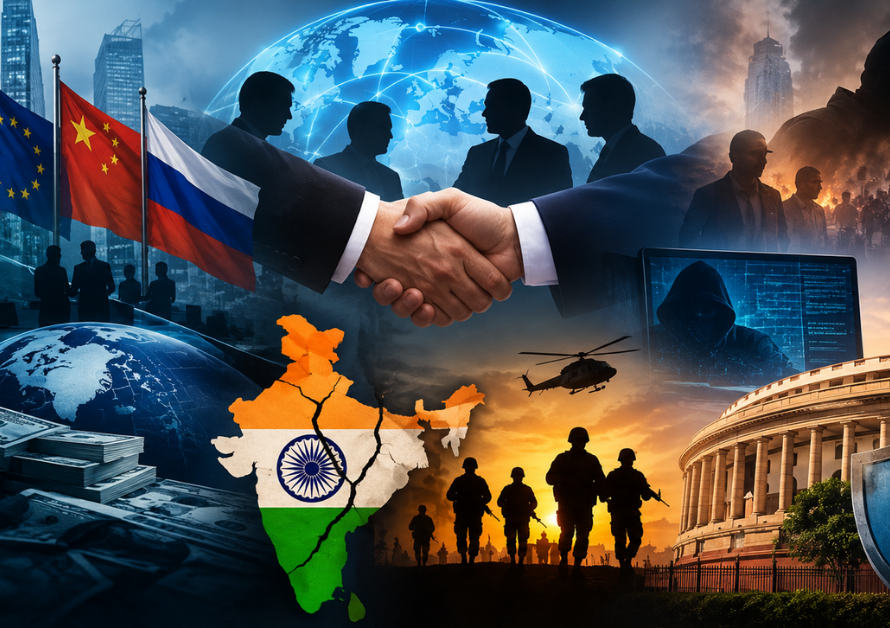
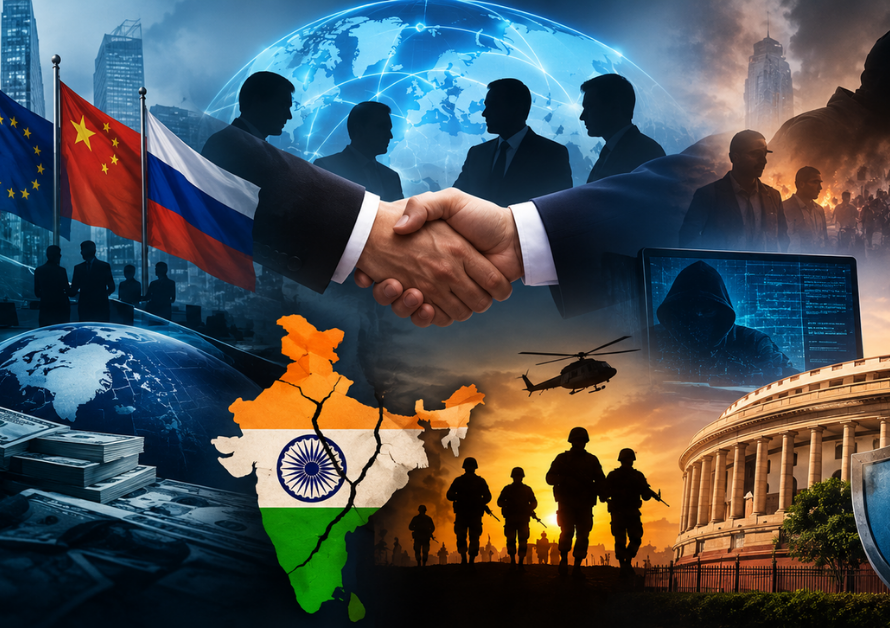
- The article highlights the pattern of suspicious links between international NGO networks (such as George Soros’s Open Society Foundation), foreign think tanks, and entities running a parallel power structure inside India (such as the National Advisory Council – NAC).
- It outlines how the repeal of anti-terror laws (POTA), the “goodwill” release of terrorists, international complexities during the Kandahar plane hijacking, and high-level unrecorded foreign visits were part of a systematic “narrative warfare” and ideological sabotage against India’s internal security and sovereignty.
Unraveling Global Alliances, Parallel Power Structures, and National Security Concerns (1991–2016)
1. The Emergence of the Rajiv Gandhi Foundation and International Networks (1991–1994)
On June 21, 1991—exactly one month after the brutal assassination of former Prime Minister Rajiv Gandhi on May 21, 1991—the ‘Rajiv Gandhi Foundation’ (RGF) was established. This was followed by a rapid expansion of its network at the international level, raising several policy and ideological questions:
- Rapid Formation and Institutional Structure of the Foundation:
- Within just 30 days of the tragic assassination, the framework for a massive NGO was prepared, which in the coming years received significant policy authority as well as corporate and foreign financial assistance.
- In the history of Indian politics and policymaking, the establishment of an NGO run by a political family at such speed and functioning parallel to the government apparatus was an unprecedented occurrence.
- Foreign Branches and High-Level Visits (1993):
- In the year 1993, Sonia Gandhi visited the United Kingdom, where she officially launched the British branch of the Rajiv Gandhi Foundation. Special resolutions regarding this were passed in the presence of representatives from the British Parliament and government.
- In that same year (1993), Sonia Gandhi also traveled to the United States. Coincidentally, in 1993, American billionaire George Soros established the ‘Open Society Foundation’ (OSF) in New York, which later played a central role in influencing global politics and leftist narratives.
- The ‘Free Kashmir’ Agenda and the FDL-AP Platform:
- In December 1994, an international NGO called the ‘Forum of Democratic Leaders in the Asia-Pacific’ (FDL-AP) was formed. An unstated and primary objective of this platform was to promote the ‘Free Kashmir’ narrative on international stages.
- As Chairperson of the RGF, Sonia Gandhi became the Co-Chair of this forum.
- Almost all members of the FDL-AP were associated with pro-Western and pro-US groups, and the organization was heavily funded by George Soros’s Open Society Foundation. The top-level participation of Indian political leadership on a platform that questioned India’s territorial integrity represented a serious strategic anomaly.
2. The Kandahar Plane Hijacking (1999) and Masood Azhar’s International Network
In December 1999, the hijacking of Indian Airlines flight IC-814 was an extremely challenging and controversial turning point for security forces and diplomacy in modern India’s history.
- The Paradox of International Diplomacy:
- After taking off from Kathmandu, when the hijacked plane landed at Al-Ain Airport in the United Arab Emirates (UAE) to refuel, a strange situation arose.
- UAE authorities immediately permitted the US Ambassador to enter the airport and monitor the situation, but Indian diplomatic representatives were barred from entering. This incident highlighted Indian diplomatic vulnerability and the excessive influence of Western powers during that era.
- The Mysterious Taliban, US, and FBI Angle:
- The aircraft was eventually taken to Kandahar in Afghanistan, which was under Taliban control at the time. During that period, the US maintained behind-the-scenes contact with the Taliban and Afghan Mujahideen after countering Soviet influence.
- The terrorists initially demanded the release of 36 radical extremists held in Indian jails and $110 million.
- Among the list of 36 terrorists, the American investigative agency, the FBI, had a special interest in Maulana Masood Azhar. While Masood Azhar was in an Indian prison between 1995 and 1998, FBI officials had directly interviewed him multiple times.
- The Formation of Jaish-e-Mohammed and the ‘Latif’ Puzzle:
- After intense negotiations, an agreement was reached to release only 3 terrorists (Masood Azhar, Omar Sheikh, and Mushtaq Zargar). A dangerous terrorist named ‘Shahid Latif’, who was included in the original list of 36 terrorists, was not released at that time.
- Immediately after his release, Masood Azhar reached Karachi under the protection of the Pakistani intelligence agency ISI and laid the foundation for the notorious terrorist organization ‘Jaish-e-Mohammed’ (JeM), whose stated goal was to spread jihad in India and sever Kashmir from the nation.
3. Suspicious Foreign Trips, Closed-Door Meetings, and the Parliament Attack (2001)
In June 2001, Sonia Gandhi embarked on a 5-day visit to the United States along with her top political associates (Manmohan Singh, Natwar Singh, Murli Deora, Jairam Ramesh). The itinerary and meetings during this trip raised several strategic questions.
- The Tax Haven Route:
- Before reaching the US, the delegation visited the United Kingdom and Iceland. Both of these regions are known in the global financial system as ‘tax havens’ and hubs for offshore banking.
- Closed-Door Meetings with the Council on Foreign Relations and Kissinger:
- Upon arriving in the US, Sonia Gandhi held rounds of closed-door meetings with representatives from the ‘Council on Foreign Relations’ (CFR) and former US Secretary of State Henry Kissinger.
- A member of this delegation and senior leader, Natwar Singh, later acknowledged that Sonia Gandhi expected to meet some extremely influential ‘special people’ during this trip, although he never disclosed the names of those individuals.
- The December 13, 2001 Parliament Attack:
- Just a few months after this high-level US visit and closed-door meetings, on December 13, 2001, Pakistan-sponsored JeM terrorists launched a suicide attack on the Indian Parliament.
- The primary objective of this attack was to eliminate India’s top political leadership and create instability across the country. Coincidentally, Sonia Gandhi and several prominent leaders had left the parliament complex just minutes before the attack occurred.
4. Formation of the NAC, Repeal of POTA, and Nurturing Urban Extremism (2004–2010)
As soon as the UPA government came to power in 2004, several policy decisions were made that fundamentally weakened the country’s internal security architecture and provided institutional protection to leftist and separatist elements.
- The National Advisory Council (NAC) – Rise of a Super-Cabinet:
- After assuming power, the ‘National Advisory Council’ (NAC) was formed under the chairpersonship of Sonia Gandhi. This body was granted authority exceeding that of the elected cabinet.
- Ultra-left thinkers such as Harsh Mander, Arundhati Roy, and Jean Drèze were included in the NAC. These were the same individuals directly or indirectly linked to George Soros-funded institutions, leftist think tanks, and foreign NGOs.
- Repeal of POTA (2004):
- The UPA government’s first major policy decision in 2004 was the complete repeal of the stringent anti-terrorism law, the Prevention of Terrorism Act (POTA).
- The repeal of this law tied the hands of investigative agencies, resulting in a series of serial bomb blasts executed by sleeper cells of SIMI and Indian Mujahideen across major Indian cities (Mumbai, Delhi, Jaipur, Ahmedabad, Varanasi) between 2004 and 2014.
- Legal Protection for Urban Naxals (The Role of HRLN):
- NGOs such as the ‘Human Rights Law Network’ (HRLN) were receiving financial assistance from the Rajiv Gandhi Foundation and foreign donors (George Soros and American foundations).
- The primary function of this network was to provide free legal aid in courts to arrested Naxals, separatists, and terrorists, and to impede security force operations under the guise of human rights.
- ‘Goodwill’ Release and the Setting Free of Terrorist ‘Latif’ (2010):
- On May 28, 2010, the UPA government took a controversial decision to release 25 radical terrorists and extremists from prison as a “goodwill gesture.”
- The most shocking name in this release was ‘Shahid Latif’—the same Latif who was included in the list of 36 terrorists alongside Masood Azhar during the 1999 Kandahar plane hijacking, and whom Indian agencies had refused to release at that time. The UPA government sent him back to Pakistan in 2010 under the guise of a peace proposal.
5. Unrecorded Visits and the Pathankot Airbase Attack (2011–2016)
Between 2004 and 2014, there was an era of opacity regarding the foreign travels of the top political leadership, which raised deep concerns within security agencies.
- Absence of Official Records in RTI:
- Information requested under the Right to Information (RTI) Act revealed that the Central Government held no official government record, expense details, or meeting minutes regarding several personal foreign trips made by Sonia Gandhi between 2004 and 2014.
- Undisclosed Visits Under the Guise of Medical Checkups:
- After 2011, several confidential trips to the US were made under the name of “medical treatment.” Information about these travels was often provided informally by press spokespersons only after she had departed from India.
- In this same pattern, on November 30, 2015, she again traveled secretly to the US for 3 days.
- Pathankot Airbase Attack (January 2, 2016):
- Exactly one month after this trip, on January 2, 2016, heavily armed fidayeen terrorists from Jaish-e-Mohammed launched an attack on the strategically ultra-sensitive Pathankot Airbase in Punjab.
- Investigations by Indian agencies (NIA) revealed that the main mastermind, conspirator, and key handler of the Pathankot attack was none other than ‘Shahid Latif’—the same individual the UPA government had released from prison in 2010 as a “goodwill gesture” and sent back to Pakistan.
6. Conclusion: National Consciousness, Ideological Clarity, and Constitutional Vigilance
This entire sequence of history—from the formation of the RGF following May 21, 1991, to the 2016 Pathankot attack—cannot be viewed merely as a chain of coincidences. It serves as direct evidence that when a nation’s policies, laws, and security framework fall under the influence of foreign funding, leftist NGO syndicates, and appeasement politics, the country pays a heavy price with the blood of its citizens and soldiers.
- Overhaul of the Security Apparatus:
- Over the past decade, India has completely transformed its internal security doctrine, adopting a policy of ‘Zero Tolerance’. Laws like the UAPA have been strengthened, suspicious foreign NGO funding has been clamped down through strict FCRA rules, and the parallel NGO syndicate of Lutyens’ Delhi has been dismantled.
- Call for Ideological Vigilance:
- To keep India a secure, prosperous, and self-respecting nation, citizens must not limit their focus to border security alone. Society must recognize the ideological sabotage posed by “Urban Naxals”, foreign toolkits, and invisible networks working to weaken India from within. Until national interests and Sanatana principles remain paramount, the permanent elimination of these historical threats to India’s sovereignty will not be possible.
🇮🇳Jai Bharat, Vandematram 🇮🇳
Read our previous blogs 👉 Click here
Join us on Arattai 👉 Click here
👉Join Our Channels👈