Summary
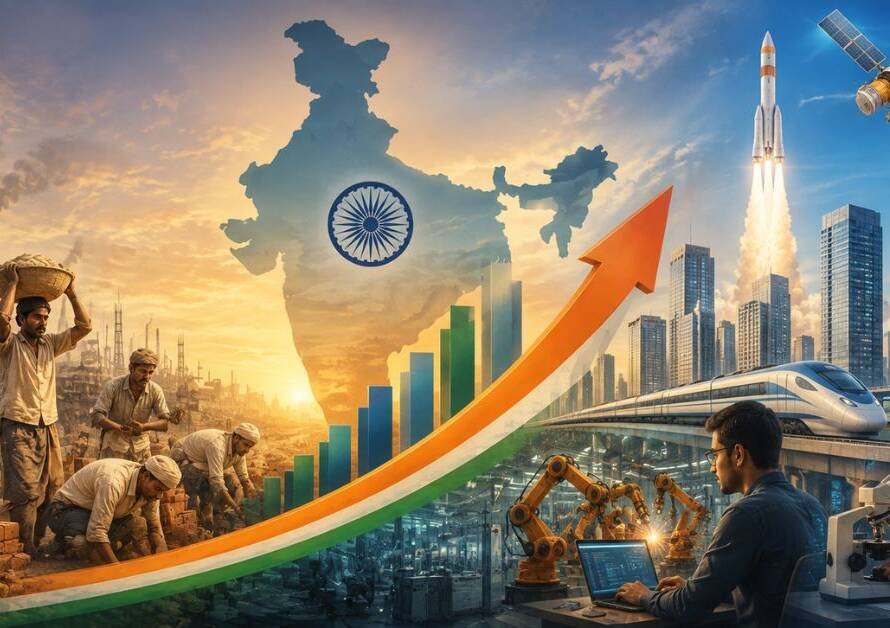
- Recent social media narratives alleging a sudden downfall in India’s economic standing—citing its current placement at the 6th position globally with a nominal GDP of $3.92 trillion for FY2025–26—represent a significant misinterpretation of macroeconomics facts.
- The primary metric of underlying economic health is real GDP growth rate. India remains the fastest-growing major economy in the world, maintaining a robust growth rate of approximately 6.5% to 7.7%. This is a vastly superior performance compared to peer nations like Japan and the UK, which are expanding at around 1.5% or less.
- The shift in nominal rankings is almost entirely driven by foreign exchange mechanics—specifically, the relative exchange rate movements of the Indian Rupee against the US Dollar. A controlled, competitive exchange rate is a strategic asset for an expanding economy. It naturally disincentivizes non-essential imports, boosts global competitiveness for exports, and incentivizes domestic manufacturing.
- To maximize the strategic benefits of this controlled currency framework, active civic alignment is required through “Swadeshi” consumption patterns. By reducing reliance on foreign products, choosing domestic alternatives, and supporting government initiatives to settle international trade in non-US Dollar currencies, India secures its foreign exchange reserves, strengthens internal supply chains, and accelerates its long-term trajectory toward becoming the world’s 3rd largest economy.
India’s Economic Position in the Global Economy
1. Parliamentary Reality vs. Social Media Rumors
- Official Confirmation: Minister of State for Finance Pankaj Chaudhary confirmed in a written reply to the Rajya Sabha that according to the IMF’s World Economic Outlook, India’s nominal GDP for FY2025–26 stood at $3.92 trillion, placing it 6th globally.
- The Comparison Gap: Social media commentary framed this ranking as a structural failure by comparing it to preliminary mid-2025 projections that had temporarily placed India near the 4th spot.
- Misleading Context: Online commentary frequently treats nominal rankings converted to US Dollars as a direct proxy for economic health, ignoring actual output levels, industrial activity, and domestic growth rates.
- Data Baselines: The figure reported in Parliament is derived from nominal GDP conversions at prevailing exchange rates, which naturally fluctuate alongside global currency markets rather than reflecting internal economic contraction.
2. Real GDP Growth: The True Measure of Economic Health
- World-Leading Growth Rate: The underlying engine of India’s economy is expanding at a real GDP growth rate of roughly 6.5% to 7.7%, making it the fastest-growing major economy globally.
- Stagnation in Peer Economies: Economies ranked alongside India, such as Japan and the United Kingdom, are experiencing sluggish economic expansion, with real GDP growth rates hovering around 1.5% or lower.
- Production vs. Conversion: Real GDP measures the actual volume of goods produced, infrastructure built, and services rendered within national borders. By this fundamental metric, India is widening its production lead over slower-growing developed nations every quarter.
- Purchasing Power Parity (PPP): When adjusted for local living costs and domestic purchasing power rather than fluctuating USD exchange rates, India is solidly the 3rd largest economy in the world, trailing only the United States and China.
3. Exchange Rate Mechanics: The Mechanics Behind the Nominal Shift
- Currency Conversion Impact: Nominal GDP rankings require converting local currency totals into US Dollars. Even when domestic economic output grows strongly, a relative depreciation of the Rupee against the US Dollar lowers the converted dollar figure on paper.
- Tight Clustering Effect: The nations occupying the 3rd through 6th positions (Germany, Japan, UK, India) sit within a narrow band of nominal valuation. In such a tight cluster, minor movements in currency exchange rates or inflation rates cause countries to periodically swap spots without any change in real economic output.
- Controlled Lower Valuation: A lower exchange valuation of the Rupee is not a sign of economic distress. Controlled currency pricing makes domestic goods more price-competitive in global export markets.
- Import Reduction: A controlled local currency naturally increases the relative cost of imported goods, encouraging domestic buyers and industries to look for local alternatives instead of foreign suppliers.
4. Strategic Advantages of Currency Management and Export Promotion
- Enhancing Export Competitiveness: A competitive exchange rate lowers the cost of Indian-manufactured goods for foreign buyers, boosting order volumes across textiles, pharmaceuticals, engineering goods, and IT services.
- Fostering Domestic Manufacturing: High import costs create a protective economic buffer for domestic producers, incentivizing local entrepreneurship and strengthening industrial capacity under initiatives like Make in India.
- Job Creation in Export Sectors: Higher demand for competitive exports directly stimulates job creation in labor-intensive manufacturing and technology services.
- Resource Preservation: Discouraging non-essential foreign imports reduces unnecessary capital outflow, preserving national foreign exchange reserves for critical energy and technology acquisitions.
5. Civic Alignment: Championing the Swadeshi Philosophy
- Reducing Import Dependence: Citizens can actively strengthen national economic resilience by consciously choosing domestically produced goods over foreign-made consumer products.
- Strengthening Local Supply Chains: Supporting local enterprises builds sustainable industrial ecosystems that reduce vulnerability to global supply chain shocks.
- Retaining National Capital: Purchasing local alternatives keeps wealth circulating within the domestic banking system, generating tax revenues for public infrastructure development.
- Lifestyle Adaptation: Adapting everyday purchasing preferences to prioritize Indian substitutes buffers households against inflation linked to imported commodities.
6. Government Countermeasures: Non-Dollar Trade Mechanisms
- Bilateral Currency Settlements: The government is actively establishing trade agreements with key trade partners to settle cross-border transactions directly in Rupee or partner currencies, bypassing the US Dollar.
- De-Dollarization Strategy: Expanding non-USD settlement mechanisms shelters critical national imports—such as crude oil, fertilizers, and raw materials—from foreign exchange volatility.
- Reducing Transaction Friction: Trading in local currencies lowers conversion costs for import-export businesses, improving efficiency across international supply networks.
- Long-Term Currency Stability: By diversifying away from absolute US Dollar dependence, India builds a resilient financial buffer against external macroeconomic pressures.
🇮🇳Jai Bharat, Vandematram 🇮🇳
Join us on Arattai 👉 Click here
👉Join Our Channels👈
Reads & Views: 42