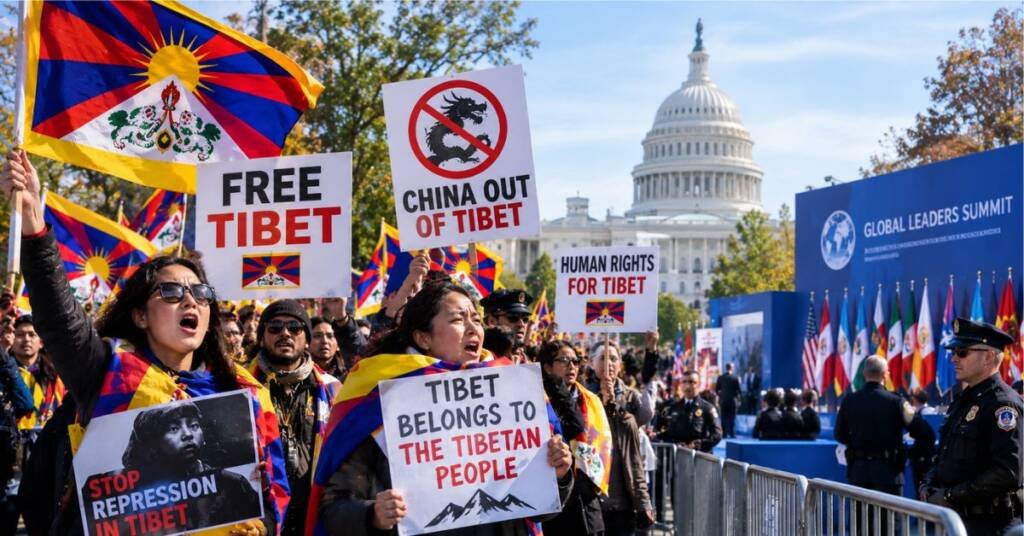
Summary
- This comprehensive narrative analyzes the major anti-CCP protest organized in Washington, D.C. during Chinese President Xi Jinping’s high-profile summit with U.S. President Donald Trump.
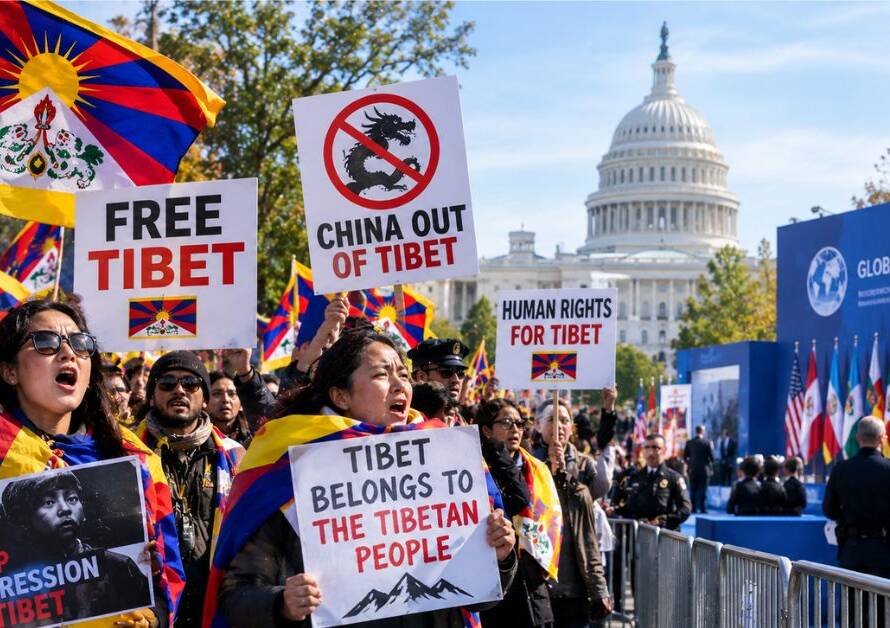
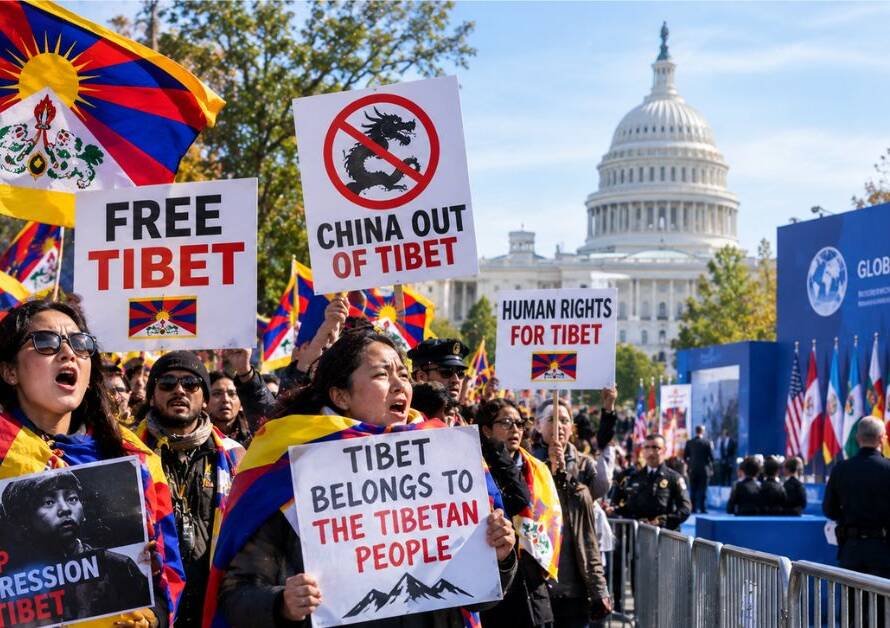
- Over 2,000 demonstrators—comprising Tibetan, Uyghur, Hong Konger, Southern Mongolian, and Chinese pro-democracy groups—marched outside the Chinese Embassy and Capitol Hill to challenge Beijing’s systemic human rights abuses, forced cultural assimilation, and transnational repression.
- Furthermore, the article addresses the paradox of China’s aggressive land grabs and border encroachments into India and neighboring nations despite its massive landmass.
- It contrasts expansionist doctrines, state coercion, and radical ideologies (such as Jihad and Khilafat frameworks) with the universal, inclusive principles of Sanatan Dharma—offering a spiritual and philosophical roadmap grounded in non-violence, mutual respect, and global harmony (Vasudhaiva Kutumbakam) for the peaceful survival of humanity.
We Want China Out of Tibet
1. High-Stakes Summit Timing and Cross-Community Solidarity
The march coincided directly with bilateral diplomatic talks in Washington between the two heads of state. For diaspora communities, the presence of the Chinese leader presented an essential window to demand that human rights, religious freedom, and state-sponsored intimidation be placed at the forefront of global diplomacy.
- A Broad Inter-Group Coalition: Historically distinct movements—including Tibetans demanding political freedom, Uyghurs protesting mass internment, Hong Kongers fighting for constitutional liberties, Southern Mongolians, and Falun Gong practitioners—demonstrated an unprecedented unified front.
- Strategic Geopolitical Platform: Demonstrators deliberately leveraged international media coverage focused on the presidential summit. The rally began outside the Chinese Embassy before demonstrators marched toward the U.S. Capitol, their chants echoing along the avenue: “We want China out of Tibet”.
- Massive Geographic Mobilization: Drawing activists from across the United States and Canada, the protest showcased the organizational maturity and resilience of overseas dissident networks despite state-sponsored attempts to fracture them.
2. Institutionalized Repression and Documented Systemic Abuse
The grievances voiced in Washington are supported by extensive documentation from multilateral organizations, United Nations reports, and independent human rights monitors.
- Separation of Families and Cultural Erasure: Omer Kanat, Executive Director of the Uyghur Human Rights Project, detailed the systematic pressures facing minority communities, including arbitrary detention, forced labor, mass surveillance, and forced family separation.
- Tibetan Residential School System: Independent UN experts have repeatedly raised alarms regarding state-run boarding school systems in Tibet, which separate over one million Tibetan children from their families, native language, and cultural traditions in a forced assimilation campaign.
- Xinjiang and the Uyghur Crisis: The UN Office of the High Commissioner for Human Rights (OHCHR) has documented severe human rights violations in Xinjiang, concluding that policies involving mass internment, surveillance, and forced labor may constitute crimes against humanity.
- Persecution of Faith Movements: The suppression extends beyond ethnic minorities. Since 1999, China has systematically targeted spiritual movements like Falun Gong. Organizations such as the U.S. Commission on International Religious Freedom (USCIRF) and the Congressional-Executive Commission on China (CECC) continue to report ongoing surveillance, extrajudicial detention, and criminal prosecution of practitioners.
3. The Paradox of Territorial Greed: Border Aggression and Regional Destabilization
A primary concern uniting critics worldwide is the paradox of China’s territorial expansionism. Despite already possessing a massive geographic landmass, Beijing’s persistent annexation and border encroachments—ranging from the military occupation of Tibet to aggressive land grabs along Indian borders and the South China Sea—raise fundamental questions about geopolitical greed.
- Erosion of Buffer Zones: The historical occupation of Tibet eliminated a natural, peaceful buffer zone between major Asian civilizations, bringing militarized tensions directly to India’s northern borders and altering Himalayan security dynamics.
- Unnecessary Regional Conflicts: Aggressive land grabs sacrifice world peace and regional harmony, forcing neighboring nations like India to divert vital economic resources toward border defense rather than human development and poverty alleviation.
- Disruption of Global Coexistence: Imperialist expansionism and state-sanctioned territorial disputes create volatile flashpoints that destabilize international law, supply chains, and peaceful coexistence among sovereign states.
4. Transnational Repression: The Weaponization of Family and Fear
A central driver of the protest was the persistent shadow of transnational repression—a strategy wherein authoritarian security apparatuses extend beyond sovereign borders to silence overseas dissidents.
- Hostage-Taking by Proxy: Activists living in Western democracies must weigh speaking freely against the safety of relatives remaining at home. Threats of job loss, interrogation, or internment directed at family members in China are routinely deployed to enforce silence abroad.
- Digital Surveillance and Intimidation: Overseas dissidents face coordinated cyber-harassment, digital tracking, and physical surveillance by state-aligned agents operating within foreign jurisdictions.
- The Paradox of Overseas Protest: The Washington rally highlighted a stark psychological contradiction: while Chinese diaspora groups marched for basic freedoms in a foreign capital, many did so under the constant fear that their public participation could spark retaliation against loved ones thousands of miles away.
5. Countering Radical Ideologies and the Path of Universal Sanatan Harmony
Beyond geopolitical land grabs, global peace faces equal danger from radical expansionist doctrines, forced religious conversions, and militant ideologies such as Jihad and Khilafat frameworks. To ensure human survival and true global peace, such aggressive and dogmatic philosophies must be strictly contained and countered.
- The Imperative for Ideological Containment: Ideologies that enforce unilateral conversion, dogmatic supremacy, or imperialist domination—whether political or religious—inevitably lead to violence, social fragmentation, and civilizational conflict.
- The Sanatan Philosophy for World Peace: In contrast to expansionist or aggressive doctrines, the foundational principles of Sanatan Dharma offer a universal, inclusive framework for world peace. Grounded in Vasudhaiva Kutumbakam (“The World is One Family”) and Sarve Bhavantu Sukhinah (“May All Beings Be Happy”), Sanatan principles emphasize:
- Absolute respect for diverse spiritual paths without forced conversions or ideological hegemony.
- Peaceful coexistence with nature, humanity, and neighboring societies.
- Self-realization, truth (Satya), and non-violence (Ahimsa) as core guidelines for governance and personal life.
- A Global Imperative: If humanity is to survive and build a peaceful, sustainable planet, global leadership must reject expansionist agendas, geopolitical greed, and religious radicalism in favor of these universal Sanatan values.
6. Strategic Outlook and Call for Global Accountability
The Washington demonstration served as a stark indictment of authoritarian governance and aggressive expansionism. A confident government should address the grievances of its citizens directly rather than driving critics onto the streets of foreign capitals.
- Generation-Level Resistance: The active participation of younger, Western-educated diaspora members indicates that cultural identity and political resistance are adapting across generations, defying state attempts to erode heritage over time.
- Demand for Global Leadership: As world leaders negotiate trade and geopolitical strategy with Beijing, the protesters’ fundamental message remains clear: international diplomacy must not turn a blind eye to territorial aggression or systemic human rights abuses. World leaders meeting Xi Jinping must directly advocate for sovereign integrity, universal human rights, and the peaceful principles that foster global harmony.
🇮🇳Jai Bharat, Vandematram 🇮🇳
Read our previous blogs 👉 Click here
Join us on Arattai 👉 Click here
👉Join Our Channels👈