Summary
- This detailed analytical article closely examines the deep contradictions of ‘equality versus selective appeasement’ embedded within India’s constitutional framework, colonial legacy, and modern politics.
- The text presents an in-depth study of how India’s model of secularism gradually transformed into a tool for one-sided state control, financial disparity, and neglect of the majority community.
- Analyzing recent administrative examples from Karnataka and Tamil Nadu, religious freedom acts, practical interpretations of Articles 25 to 30 of the Constitution, and the impact of state endowment laws on Hindu temples, this article outlines a solid roadmap for policy reforms.
- Ultimately, it conveys a message emphasizing coordination between a patriotic government and the judiciary, strict enforcement of constitutional mechanisms, and the importance of all sections of society—including Buddhists, Jains, Sikhs, and all streams of the Sanatana tradition—recognizing their shared civilizational roots.
Constitutional Justice And The Challenge Of Institutional Equality
I. Selective Secularism And Constitutional Anomaly
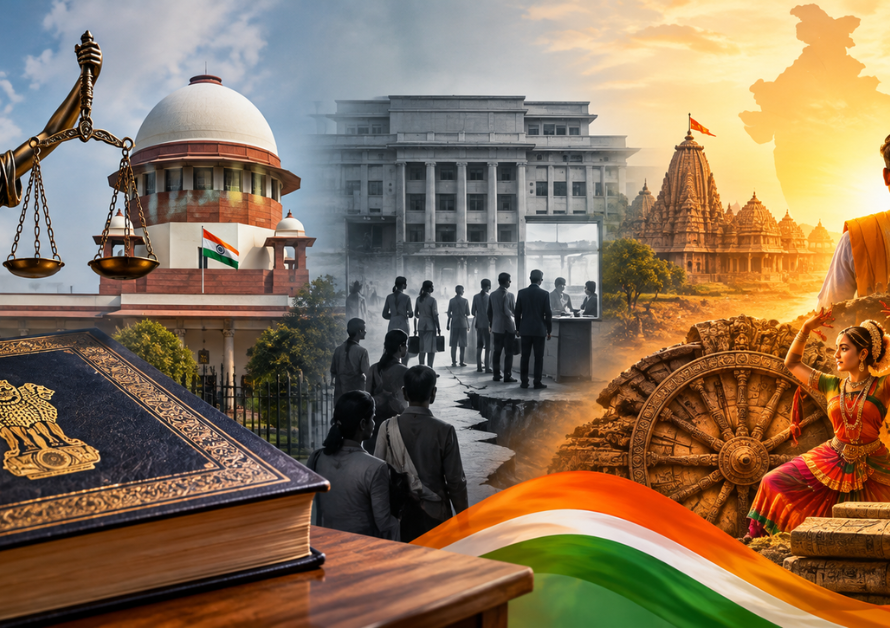
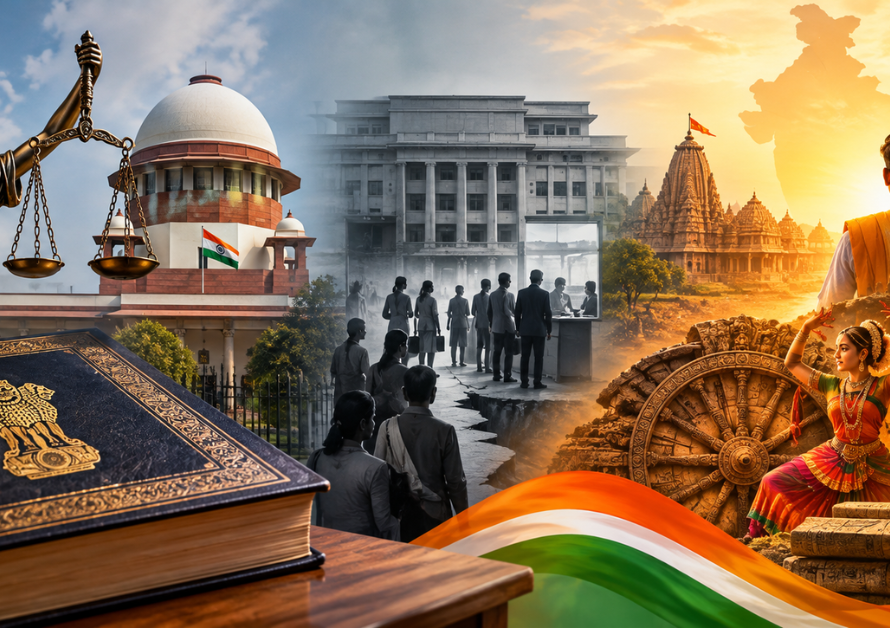
The original purpose of inserting the word ‘Secular’ into the Preamble of the Constitution of India was to ensure that the state has no official religion and treats all citizens equally. However, the manner in which it has been implemented over the past few decades has given rise to a unique institutional disparity.
- Practical Dichotomy of Articles 25 to 30: Article 30 of the Constitution grants minorities the right to establish and administer educational institutions of their choice. In practical politics, however, this has meant that the majority community faces complex regulations and state interference (such as the mandatory implementation of the RTE Act) to run educational institutions according to their religious and cultural traditions, while minority institutions remain exempt from these obligations.
- Violation of the Right to Equality (Article 14): When state policies determine budgetary allocations, tax exemptions, or direct financial assistance solely on the basis of a specific religious identity, it directly challenges the core spirit of Article 14 of the Constitution (Equality before Law).
- Western vs. Indian Model: In Western countries, secularism signifies a complete separation between the state and religion. In contrast, in India, it has manifested as ‘state intervention in all religions’—resulting in hyper-regulation over the majority community and complete autonomy for minority communities.
- Institutional Imbalance: The tendency of the state to grant one-sided protection has created an environment where even law-abiding members of the majority community are forced to approach the courts merely to protect their fundamental cultural rights.
II. Case Study Of Southern States: Policy Directions And Financial Disparity
Recent policies in southern states like Karnataka and Tamil Nadu present a clear example of how state budgets and administrative powers are being utilized to create a one-sided socio-political balance.
- 1. Inequality in Educational and Skill Development Schemes:
- In Tamil Nadu, dedicated budgetary funds have been allocated for specific religious minorities to provide free education up to graduation, scholarships at the matriculation level, and skill training in sectors like IT, beauty, and garments.
- The issue lies not with the welfare intent itself, but with its ‘exclusivity.’ When a non-minority student from the same economic background is excluded from these government benefits solely due to their religion, it leads to state-sponsored inequality.
- 2. Government Concessions and Funds for Religious Institutions:
- Budgets exceeding ₹100 crore and interest-free loans have been arranged for the construction and renovation of minority religious sites, marriage halls, commercial complexes, and training centers.
- The commercial utilization of these funds (earning income by constructing commercial complexes and halls) strengthens their economic base, whereas the state shares no such institutional support with the religious complexes of the majority community.
- 3. Linguistic and Cultural Shifts:
- In Karnataka, mandating specific languages in Anganwadis or at the primary level, waiving over ₹800 crore in taxes, and reversing judicial and administrative guidelines regarding the hijab highlight how policies are repeatedly altered for political gains, thereby impacting administrative stability.
- 4. Political Use of Public Funds:
The duty of a welfare state is to allocate resources on a transparent and equitable basis. When allegations of irregularities emerge in sectors like coal allocation alongside the selective deployment of budgetary funds for specific groups, it undermines the principles of good governance.
III. Temple Control Laws: Modern Form Of Colonial Exploitation
The greatest anomaly regarding religious freedom and state intervention in India is visible in the ‘Hindu Religious and Charitable Endowments Act’ (HR&CE Act), a legacy of colonial-era laws from the Madras Presidency.
- The Scope of Government Control Over Temples:
- Across the country, particularly in South India, over 1,00,000 prominent Hindu temples are under the direct control of state government endowment departments.
- In contrast, no mosque, church, or gurudwara is managed by the government; they operate completely independently through their respective trusts and boards.
- Exploitation of Revenue and Neglect:
- A substantial portion of the millions collected through donations and offerings at major and wealthy temples (such as Tirupati, Meenakshi, Thanjavur, Jagannath, etc.) goes toward administrative fees and state government departmental accounts.
- Ironically, in the same states, more than 34,000 smaller and rural temples face severe financial crises, and over 12,000 temples have shut down completely. Thousands of temples lack basic daily rituals and livelihood support for priests, while several historic structures lie in ruins.
- Encroachment of Temple Lands:
- Despite government control, hundreds of thousands of acres of fertile agricultural land and valuable urban properties belonging to temples have been leased out at throwaway prices or illegally sold over past decades. This revenue has never been reinvested into Hindu culture or the restoration of dilapidated temples.
- Destruction of Religious Heritage:
- When funds are not made available for the maintenance of ancient temples, it is not merely a structural loss; it represents a permanent loss of the region’s architecture, classical music, sculpture, and intangible cultural heritage.
IV. Coordination Between Government And Judiciary: Constitutional Rigor And Prevention Of Abuse
To curb the politics of appeasement implemented for decades by the Congress and its alliance partners (“Thugbandhan”), as well as the ongoing one-sided policies in opposition-ruled states, it is high time that the nation’s administrative and judicial mechanisms join hands.
- Strict Enforcement of Constitutional Provisions: A patriotic central government and the country’s apex judiciary must ensure that articles of the Indian Constitution (specifically Articles 14, 15, and 25–30) are not misused for political self-interest and vote-bank appeasement.
- Judicial Review of Biased State Laws: The judiciary must conduct strict reviews of state-level laws and budgetary allocations that create discrimination among citizens based on religion.
- Accountability of Constitutional Institutions: The Election Commission, enforcement agencies, and courts must take decisive action against political parties and state governments that misuse public resources and colonial-era laws (such as the HR&CE Act) for partisan and electoral gains.
V. Civilizational Unity And Roadmap For The Future
To preserve social harmony in India, it is essential to end this cycle of appeasement and establish a framework where every citizen receives equal opportunities and equal rights.
- 1. Consciousness of the Banyan Tree (Civilizational Unity):
- Sanatana culture is not a narrow dogma or sect; it is a vast banyan tree. Buddhism, Jainism, Sikhism, Brahmins, Baniyas, Kashyaps, and various philosophical traditions and social streams are all branches emerging from this single trunk.
- Historically, whenever these branches of India were turned against one another or severed from their roots, the nation lost its political and cultural sovereignty.
- 2. Demand for the Freedom of Temples (Free the Temples):
- The role of the state is to govern and provide basic amenities, not to manage temples or religious trusts.
- The management of temples should be handed over entirely to devotees, scholars, and local religious trusts, and their revenue should be used exclusively for Sanskrit education, Veda Pathshalas, Ayurveda research, and the welfare of the needy.
- 3. Welfare Based on Economic Need:
- The sole criterion for all government welfare schemes (scholarships, skill development, commercial loans) should be ‘economic status,’ not religion or caste.
- 4. Citizen Awareness and Constitutional Rights:
- Transformation in a democracy comes not just through speeches, but through informed voting and vocal demands for constitutional rights. Until citizens become conscious of their cultural heritage, policies will not shift in their favor.
🇮🇳 Jai Bharat, Vandematram 🇮🇳
Read our previous blogs 👉 Click here
Join us on Arattai 👉 Click here
👉Join Our Channels👈