Executive Summary
- This comprehensive narrative analyzes the profound shift in India’s international standing over the last twelve years, contrasting verified global milestones with the polarized domestic political discourse.
- It highlights how international icons like Hollywood actor Richard Gere, global industrial leaders, and multilateral institutions like the World Bank validate India’s structural, economic, and cultural renaissance.
- Concurrently, it deconstructs the systematic, fear-driven narratives propagated by a domestic opposition ecosystem that consistently misrepresents India’s progress on the global and digital stage.
Global Recognition of India’s 12-Year Transformation
1. The Paradigm Shift in Global Perception
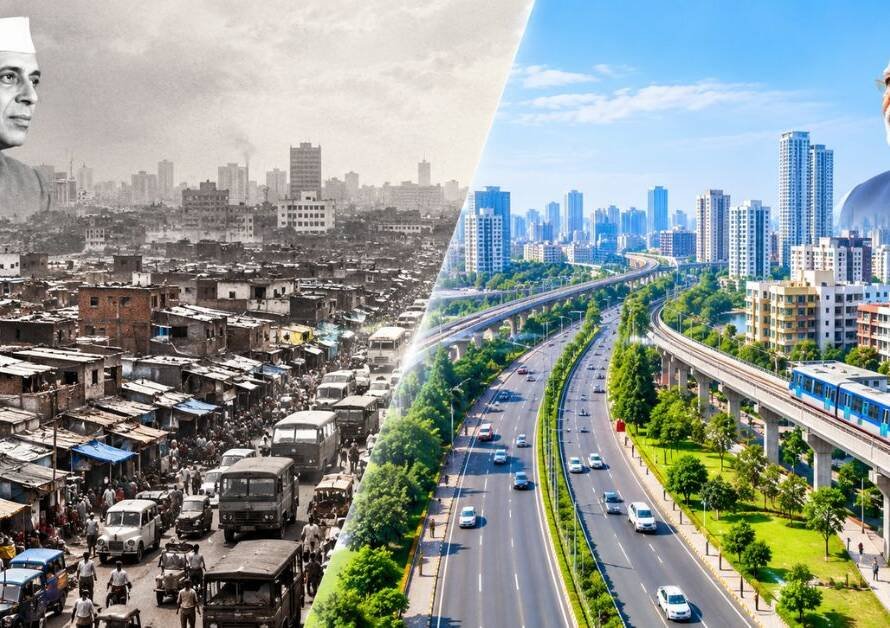
For decades, international discussions surrounding India were dominated by its immense “potential”—a polite euphemism for a nation perpetually held back by administrative inertia, policy paralysis, and systemic vulnerabilities. Over the last twelve years, however, this narrative has undergone a radical transformation.
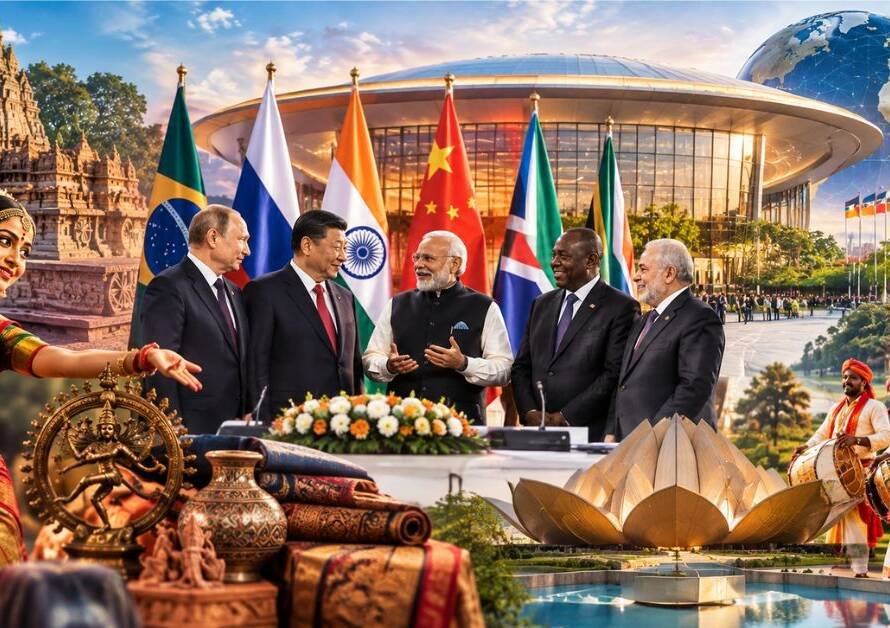
- A Confident Civilizational State: India is no longer viewed merely as a massive post-colonial marketplace or a secondary hub for back-office operations. It is increasingly recognized as a confident civilizational state that articulates its national interests with strategic clarity and sovereign independence.
- A Dual Engine of Growth and Value: The global community now looks to India as both an economic powerhouse capable of anchoring global supply chains and a cultural anchor whose ancient ethos offers timeless solutions to modern global friction.
- Validation Beyond Politics: This respect transcends routine diplomatic protocols. It is explicitly voiced by international cultural figures, global corporate executives, and stringent multilateral financial bodies that base their assessments purely on structural performance and economic resilience.
2. The Fusion of Civilizational Identity and Modern Statesmanship
A defining characteristic of India’s evolution over the past twelve years is its refusal to compromise cultural identity for the sake of modern validation. Unlike previous eras where leadership frequently adopted a defensive, hyper-secularized posture that downplayed indigenous heritage to appeal to Western audiences, contemporary India embraces its roots as its greatest strength.
- The Richard Gere Benchmark: This unique synthesis of ancient values and modern administrative resolve was powerfully captured during the International Day of Yoga at the United Nations headquarters. Speaking to reporters, Hollywood actor Richard Gere explicitly described Prime Minister Narendra Modi as a “product of Indian culture” who represents a vast civilizational heritage.
- Universal Brotherhood (Vasudhaiva Kutumbakam): Gere emphasized that India’s foundational message of universal brotherhood and sisterhood is exactly what the modern world needs to hear repeatedly. This endorsement highlights that true global dignity is commanded not by mimicking external cultures, but by standing firmly rooted in one’s own civilizational truths.
- Culture as Soft Power: By elevating indigenous concepts—ranging from traditional wellness systems like Yoga and Ayurveda to eco-conscious lifestyles like Mission LiFE—India has successfully converted its cultural ethos into a potent tool of international diplomacy and soft power.
3. Empirical Evidence: The Pillars of Global Validation
International confidence is not built on public relations or rhetorical assertions; it is anchored in hard, verifiable metrics recognized by global entities, financial institutions, and multi-national corporations.
A. Industrial Growth, Manufacturing, and R&D Commitments
- Shifting Supply Chains: Global industrial titans are actively diversifying away from volatile, single-source manufacturing hubs and establishing deep roots in India.
- The Damen Shipyards Example: As detailed in international business briefings, European industrial giants like Damen Shipyards—which has maintained a presence in India since 1969 and employs thousands of local specialists—are aggressively scaling up operations.
- High-Value Research Hubs: Global CEOs explicitly state that India is no longer just a destination for low-cost labor; it is a primary ecosystem for advanced research and development. International firms are basing their core global engineering, semiconductor designs, and maritime technologies directly on Indian soil.
B. The Digital Public Infrastructure (DPI) Revolution
- Democratization of Technology: The World Bank, the International Monetary Fund (IMF), and global tech leaders regularly study India’s open-source digital architecture. Through the foundation of the India Stack, technology has been fully democratized.
- Eradication of Leakages: Financial inclusion mechanisms like Jan Dhan accounts, biometric verification, and the Unified Payments Interface (UPI) ecosystem have completely dismantled legacy systems of patronage.
- Rule-Based Governance: By transferring benefits directly to the bank accounts of citizens, the administration has successfully transitioned governance from a discretion-based model—prone to corruption and middleman leakages—to a rule-based, transparent digital system.
C. Unprecedented Poverty Alleviation and Social Welfare
- The Data on Radical Upliftment: True development is measured by a nation’s ability to protect and elevate its most vulnerable populations. According to formal data tracked by the World Bank, India witnessed a monumental drop in extreme poverty.
- Actualizing Antyodaya: This massive decline represents one of the largest and fastest extractions of humanity out of poverty in recorded history. It directly reflects the successful implementation of the philosophy of Antyodaya—ensuring that the individual at the absolute end of the socio-economic queue receives food security, housing, sanitation, and clean energy first.
- Agricultural Resilience: International agricultural and vegetable breeding executives note that India’s strategic focus on international collaboration and advanced agricultural technologies is essential for securing global food supply systems. The nation has evolved from an importer of food grains to an indispensable player in global food sustainability.
D. Macroeconomic Fortitude and Structural Reforms
- Exiting the “Fragile Five”: Twelve years ago, global financial institutions classified India among the “Fragile Five” economies due to high inflation, policy gridlock, and low investor confidence. Today, major structural overhauls—including the implementation of the Goods and Services Tax (GST), banking sector cleanups, and a massive push for domestic capital expenditure—have altered this reality.
- The Engine of Global Growth: Maintaining a consistent growth momentum tracking near 7%, India stands as the world’s fifth-largest economy. It serves as a vital beacon of stability in a global economy otherwise marred by recessions, high inflation, and geopolitical conflicts.
| Key Metric Indicator | Historic Baseline (12 Years Ago / 2011-12) | Contemporary Trajectory / 2022-23 |
| Extreme Poverty Rate | 16.2% | 2.3% (World Bank Data) |
| Global Economic Status | Categorized under the “Fragile Five” | 5th Largest Economy (Growth near 7%) |
| Governance Architecture | Discretion-Based / Middleman Leakages | Rule-Based Digital Public Infrastructure |
4. The Paradox: The Domestic Echo Chamber of Dissent
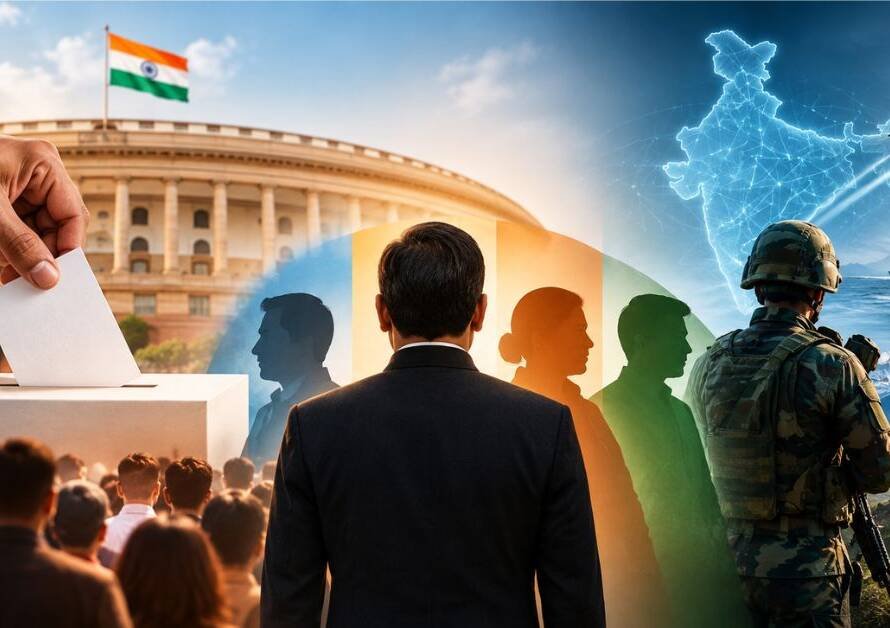
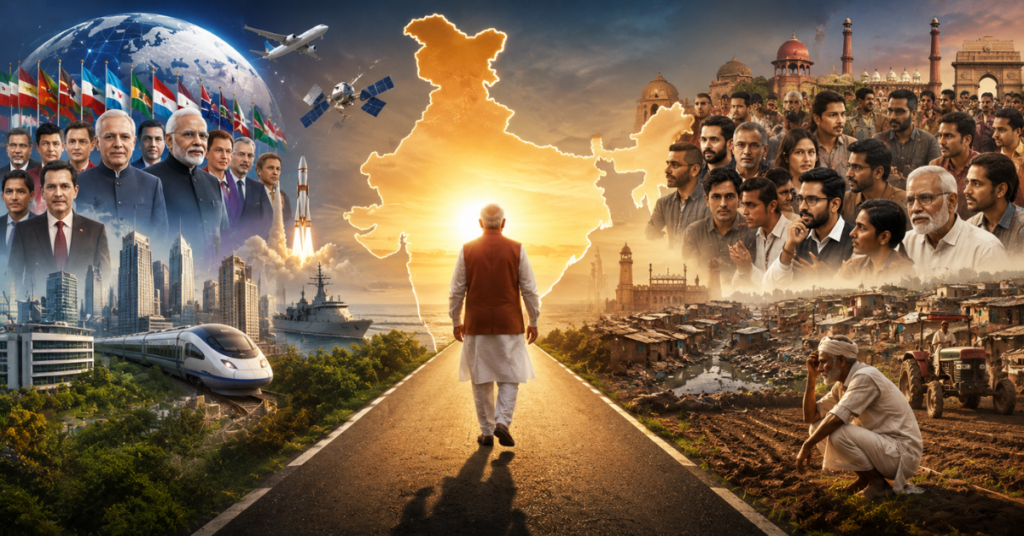
- The core irony of modern India lies in the vast, unbridgeable chasm that exists between objective global validation and the relentless, manufactured doom-mongering peddled by a highly coordinated domestic political ecosystem.
- This ecosystem—consisting of the Congress party, the broader opposition alliance, left-wing ideologues, self-proclaimed liberals, radical factions, and segments of the legacy Lutyens media—works systematically to flood platforms with alternative realities.
A. Deconstructing the Coordinated Attack Vectors
- The “Democracy in Danger” Mirage: This specific trope is deployed with mathematical predictability whenever electoral outcomes do not favor the legacy political establishment. It completely ignores record-breaking voter turnouts, the historic participation of women and youth, and transparent, digitally-verified democratic exercises.
- The “Economic Collapse” Propaganda: Despite explicit, glowing assessments from the World Bank, the IMF, and international rating agencies, this ecosystem routinely attempts to convince the public that India has “gone to the dogs” and that the administration is an absolute failure. They deliberately weaponize isolated local challenges while ignoring macroeconomic indicators.
- The Rejection of National Progress: From casting aspersions on indigenously manufactured vaccines during a global health crisis to criticizing world-class infrastructure projects like high-speed rail networks, new parliament buildings, and dedicated freight corridors, the ecosystem’s opposition borders on being anti-progress.
B. The Psychological Root of the Dissent
- The Loss of Corrupt Patronage: For decades, the legacy political establishment operated on a system of patronage, entitlement, and discretionary funding, where state resources were treated as personal fiefdoms. The implementation of digital governance, strict financial compliance, and rule-based systems has permanently choked these avenues of corruption.
- Assaulting State Credibility: Having lost the ability to control state resources internally, the remaining strategy of this ecosystem is to assault the credibility of the Indian state itself on international platforms. By actively manufacturing narrative crises, they seek to undermine foreign investment, damage national cohesion, and invite external interference into India’s sovereign affairs.
5. The Road to Viksit Bharat 2047
Despite the noise, chaos, and continuous narrative manipulation generated within the domestic echo chamber, the trajectory of the nation remains firmly unshakeable. The global community does not evaluate nations based on hyper-partisan social media trends; it evaluates them based on performance, structural execution, regulatory stability, and economic resilience. In every single one of these arenas, India is consistently delivering.
- A Transition Fully Realized: The transition from a nation of “potential” to a nation of “performance” is fully realized. The foundational structural blocks—both digital and physical—are now firmly laid.
- An Unstoppable Trajectory: The hyper-focused campaigns of the opposition ecosystem are ultimately failing to resonate with an aspirational Indian electorate that experiences the tangible benefits of clean governance, digital empowerment, and enhanced global prestige every single day.
- The Vision of 2047: As international leaders, global CEOs, and cultural icons continue to validate India’s civilizational and economic ascent, the nation is marching steadily and confidently toward its ultimate destination: a fully developed, self-reliant Viksit Bharat by 2047.
Core Takeaways for the Thinking Citizen:
Continuous Vigilance: Stay continuously aware of the coordinated, double-edged propaganda narratives deployed by adversarial networks to undermine domestic confidence.
Historical Memory: Never forget the pre-2014 era characterized by policy paralysis, unchecked institutional corruption, internal insecurity, and systemic instability.
Collective Resolve: Rise above internal, fragmented divisions to stand completely unified in the interest of national security, heritage preservation, and a protected future for our descendants.
🚩 Jai Bharat! Jai Sanatana! Vande Mataram! 🚩
Read our previous blogs 👉 Click here
Join us on Arattai 👉 Click here
👉Join Our Channels👈